Hey, I hope All are well, However listen
Last winter, my neighbor Steve spent $2,400 replacing dead grass patches after snow melted. His lawn looked like a war zone – brown circles everywhere, vole tunnels crisscrossing the yard, chickweed dominating completely.
Steve ignored basic winter maintenance. Just 20 minutes weekly could have saved him thousands. We see this every spring – some homeowners face expensive lawn restoration while others enjoy healthy turf that greens up first.
Your grass is not dormant in the traditional sense. Root systems work continuously even when blades appear lifeless. Provide them basic attention now and enjoy superior results in April.
Ready to maintain a healthy lawn through winter? Let’s explore proven strategies.
WHAT IS GRASS DORMANCY?
Turf doesn’t die when frost arrives. It enters survival mode. Visible growth stops while energy redirects underground where roots continue functioning according to ETM Lawn CareCare.
Cool-season varieties like Kentucky bluegrass (Poa pratensis) and fescue (Festuca) handle cold differently than warm-season types. Fescue maintains semi-active status during mild winter days, potentially producing slight green growth when temperatures exceed 10°C (50°F). Bermudagrass (Cynodon dactylon) and zoysiagrass (Zoysia) shut down completely until spring warmth returns.
Color changes appear first. Green blades fade to tan or light brown. Texture shifts too – grass feels crispy and brittle. This protects the plant from freeze damage by moving moisture and nutrients deep into root zones.
Distinguishing dormancy from death: Pull a grass blade gently. If it resists and bends, roots remain healthy. If it snaps easily or pulls out without resistance, the grass is dead. This five-second check can prevent expensive spring replacement.
Most lawns enter dormancy when soil temperatures consistently drop below 10°C (50°F). This typically occurs late October through November depending on region.
WHY WINTER MAINTENANCE MATTERS
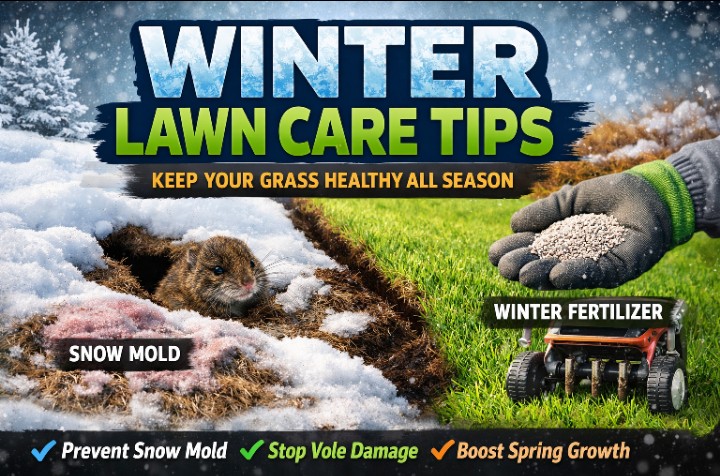
Neglecting winter care creates spring problems. Snow mold becomes a primary concern. This fungal disease thrives on neglected turf covered by snow. Pink and gray circular patches spread rapidly under white cover. By the time snow melts, damage is already severe according to LawnStarter Mold Guide.
Many weed species germinate in cold soil. Chickweed (Stellaria media), henbit (Lamium amplexicaule), and deadnettle establish deep root systems while turf rests. Come spring, they’re mature and difficult to remove without damaging surrounding grass.
Voles (Microtus species) become active hunters under snow cover. These small rodents tunnel extensively, consuming grass roots and crowns. Damage becomes visible in March. Missouri Extension research shows vole damage costs homeowners billions annually in lawn restoration.
The time investment is minimal. Twenty minutes weekly prevents weekend-long spring repairs – invest 6 hours across winter or spend 40+ hours fixing spring damage.
PRE-WINTER PREPARATION STEPS
Late fall preparation determines winter survival success. Complete these tasks before first hard freeze.
Final mowing height: Set mower blade to 6.4 cm (2.5 inches) exactly. This height protects grass crowns from direct cold exposure while preventing snow mold establishment in overly tall grass. Cutting too short exposes vulnerable plant crowns to freeze damage. Leaving grass too long creates matted layers conducive to fungal disease development.
Soil aeration: Break up compaction, especially in clay soils. Punch holes 5-8 cm (2-3 inches) deep across your entire lawn. Roots need oxygen even during dormancy. Water needs drainage pathways to prevent ice formation around crowns. September through early October provides ideal aeration timing for cool-season grasses.
Winter fertilizer application: Choose formulas high in potassium (K) and low in nitrogen (N). Potassium strengthens cell walls against freeze damage. Nitrogen encourages growth when plants should be hardening off. Apply this specialized fertilizer in early November before ground freezes solid. Look for NPK ratios like 5-10-30 or similar winter-specific blends.
Overseeding thin areas: Cool-season grass seed germinates in fall temperatures. New plants establish strong roots before winter truly arrives. Come spring, they’re already mature and filling bare spots naturally.
Pre-Winter Preparation Timeline:
1. Final Mowing (Late October)
– Height: 6.4 cm (2.5 inches)
– Temperature: Above 10°C (50°F)
– Benefit: Protects grass crowns from freeze damage
2. Core Aeration (September to Early October)
– Temperature: 15-21°C (60-70°F)
– Benefit: Improves oxygen access and soil drainage
3. Potassium-Rich Fertilizer (Early November)
– Temperature: Before soil freezes solid
– Benefit: Strengthens cell walls against cold stress
4. Overseed Bare Patches (Mid-September)
– Temperature: 15-24°C (60-75°F)
– Benefit: Establishes strong growth before spring
Source: [Garden Superstore Fall Guide and Yarbo’s Winter Lawn Tips
WEEKLY WINTER MAINTENANCE ROUTINE
Winter turf care continues after fall preparation. Consistent weekly attention prevents major problems.
Monday debris removal: Rake leaves and fallen branches lightly. Avoid letting organic matter accumulate. Thick leaf layers block sunlight and trap moisture – perfect conditions for snow mold. A quick 10-minute raking session prevents weeks of spring fungicide treatments.
Wednesday frost inspection: Check grass before foot traffic. Frost-covered turf is extremely fragile. Each footstep crushes frozen cells that won’t recover until spring. Those brown footprint trails visible in March originated from December frost walks. Use sidewalks and driveways instead.
Friday moisture assessment: Dormant turf still requires water during extended dry periods. If three weeks pass with no snow or rain, water lightly on days above 4°C (40°F). Target early morning application. Evening watering before overnight freezes creates ice damage around grass crowns.
After heavy snowfall: Remove snow layers thicker than 5 cm (2 inches) from high-traffic areas. Light snow insulates grass well. Heavy wet snow suffocates turf and creates ice layers blocking oxygen exchange. Shovel pathways gently without scraping down to grass level.
Avoid sodium chloride: Rock salt (NaCl) burns grass roots and destroys soil structure permanently. Sand provides traction without chemical damage. If ice melt is necessary, choose calcium magnesium acetate (CMA) formulas that are turf-safe.
Sources: ETM Winter Raking Guide, STIHL Frost Protection Tips, Percy’s Moisture Management
COMMON WINTER LAWN MISTAKES
Overwatering causes more damage than drought. Wet soil freezes into solid ice blocks. Roots cannot respire in frozen saturated soil. Water only during genuine dry spells when soil feels dusty 5 cm (2 inches) down. The goal is maintaining slight moisture, not creating mud.
Ignoring leaf accumulation kills underlying grass. Even thin leaf layers block 100% of sunlight when wet and matted. Grass underneath yellows then browns. Recovery may not occur even with spring care. Weekly raking takes minutes but preserves turf health.
Walking on frosted grass creates permanent scars. Morning walks across frost-covered turf? Each frozen blade you crush dies completely. Cell walls rupture and cannot heal. These footprint trails become brown paths visible throughout spring. Stay off frost-covered lawns completely.
Skipping fall fertilization leaves grass defensively weak. Winter stress doubles on undernourished turf. Spring recovery takes 6-8 weeks longer. The fertilizer cost saved creates exponentially higher spring renovation expenses.
Rock salt application burns grass edges permanently. Sidewalk salt doesn’t remain on concrete. It splashes onto adjacent grass with every vehicle pass and foot traffic. Sodium accumulation kills grass roots through chemical burning and soil structure destruction. Salt damage requires complete soil renovation. Sand or calcium-based alternatives prevent this damage.
Sources: LawnStarter Common Mistakes, STIHL Leaf Management, Grounds Guys Checklist
WARNING SIGNS OF LAWN STRESS
Pink or gray circular patches indicate snow mold infection. This fungal disease (Microdochium nivale and Typhula incarnata) appears immediately after snow melts. Circles range from 15 cm to 1 meter (6 inches to 3 feet) in diameter. Pink snow mold is most common. Gray snow mold appears in areas with extended snow cover. Both spread rapidly if untreated. Rake affected areas immediately to break up fungal mats. Severe cases need fungicide application.
Small tunnel systems reveal vole damage. Look for surface runways approximately 5 cm (2 inches) wide. Voles consume grass roots and crowns while traveling under snow. Damage appears as brown trails following tunnel paths. These rodents breed rapidly – one pair can produce 50+ offspring annually. Trapping becomes necessary for severe infestations.
Thick ice layers suffocate underlying grass. Ice sheets thicker than 2.5 cm (1 inch) block all oxygen exchange. Grass crowns essentially drown under solid ice. Break up thick ice gently using a plastic shovel. Metal tools damage grass crowns worse than ice itself.
Bright green weeds contrast against dormant turf. Winter annual weeds like chickweed and henbit thrive in cold temperatures. They germinate in fall and grow actively through winter. Their bright green color stands out dramatically against tan dormant grass. Remove them immediately before seed production starts. One chickweed plant produces 15,000 seeds.
Sources: LawnStarter Disease Guide, Missouri Extension Pest Management, Spring-Green Weed Control
SPRING TRANSITION TIMING GUIDE
Your lawn needs gentle awakening, not shock treatment. Rushing spring care wastes resources and damages recovering turf.
Step 1: Thorough debris removal comes first. Wait until snow completely melts and ground thaws. Rake vigorously to remove all winter debris, dead grass, and matted leaves. This allows sunlight to reach soil and stimulates new growth.
Step 2: Pre-emergent herbicide application requires precision timing. Apply exactly 2 weeks before soil temperature reaches 13°C (55°F) consistently. This window prevents crabgrass (Digitaria) seeds from germinating. Too early wastes product effectiveness. Too late means seeds already sprouted. Soil thermometers cost $10-15 and eliminate guessing.
Step 3: First fertilizer waits for 13°C (55°F) soil temperature. Use your soil thermometer daily starting in March. When readings stay at or above 13°C (55°F) for three consecutive days, apply your first nitrogen fertilizer. Earlier application feeds nothing since grass isn’t actively growing yet.
Step 4: Dethatching removes winter damage accumulation. Use a dethatching rake or power dethatcher on areas with thatch layers exceeding 1.3 cm (half an inch). Drag the rake firmly across problem sections. Grass respires better immediately afterward. Spring growth accelerates noticeably within two weeks.
Step 5: Gradual mowing prevents shock. Never remove more than one-third of grass blade height in a single mowing. If grass grew to 10 cm (4 inches), only cut down to 6.7 cm (2.7 inches). Wait several days, then mow again. Gradually work back to your target summer height of 6.4 to 7.6 cm (2.5 to 3 inches).
The pre-emergent herbicide timing matters most. Miss that critical window and you’ll battle crabgrass throughout summer.
Sources: JC Landscaping Spring Checklist, Garden Superstore Spring Guide, Percy’s Mowing Guidelines
ESSENTIAL WINTER LAWN TOOLS
Basic tools handle 95% of winter maintenance tasks. Expensive equipment isn’t necessary for successful winter lawn care.
Leaf rake ($15-30): Choose bamboo or poly models. Metal rakes damage dormant grass. A stiff broom works adequately if you already own one. Replace rakes every 2-3 seasons as tines wear.
Soil probe or thermometer ($8-15): This tool checks soil moisture and temperature accurately. Insert 10 cm (4 inches) deep. Moisture readings prevent overwatering. Temperature readings time spring applications perfectly. One purchase lasts decades.
Garden hose with spray nozzle ($20-40): Gentle spray settings prevent washing away soil during winter watering. Quick-connect fittings make setup faster. Drain hoses completely before storing to prevent freeze damage.
Work gloves ($10-20): Cold weather makes bare-hand work uncomfortable. Choose waterproof models with grip texture. Insulated versions work better below 4°C (40°F).
Core aerator (rental $50-75/day): Annual rental makes financial sense for most homeowners. One autumn aeration session per year provides adequate benefit. Rental shops include usage instructions.
Fertilizer spreader ($30-100): This investment pays for itself quickly. Broadcast spreaders work faster. Drop spreaders provide precise application. Clean thoroughly after each use to prevent rust.
Budget total: $100-150 for purchases plus $50-75 annual rental. This modest investment protects your lawn value.
Source: Yarbo Tool Guide
REGIONAL WINTER LAWN STRATEGIES
Climate zones require different winter approaches. Your USDA hardiness zone determines specific care timing and techniques.
USDA Zones 3-4 (Northern Canada, Northern US): Extended freezes last 5-6 months here. Choose extremely cold-hardy grass varieties like perennial ryegrass (Lolium perenne) blends rated to -34°C (-30°F). Apply extra potassium fertilizer in October. Light mulch around lawn edges provides additional insulation. Expect dormancy from October through April.
USDA Zone 5 (Midwest, Northeast): Heavy snow loads hit hard in these areas. Avoid applying mulch over entire lawn areas – it smothers grass underneath. Instead, use light mulch only around vulnerable edges and newly seeded sections. Heavy snow removal becomes necessary after storms exceeding 15 cm (6 inches).
USDA Zone 6 (Mid-Atlantic, Transition Zone): Fluctuating temperatures create unique challenges. Grass may cycle in and out of dormancy multiple times. Focus on proper drainage since freeze-thaw cycles increase waterlogging risk. Monitor soil moisture closely during winter warm spells.
USDA Zone 7 (Southern states, Pacific Coast): Milder winter temperatures mean less dormancy stress. Skip November fertilizer applications completely. Grass stays semi-active here and excess nitrogen encourages unwanted winter growth. Focus instead on weed prevention since winter annuals thrive in Zone 7 temperatures.
European Atlantic Climates: Wet winters pose bigger threats than cold temperatures. Root rot (Pythium species) kills more grass than freeze damage. Improve drainage before November. Consider installing French drains in problem areas. Raise low spots with quality topsoil.
Western US Dry Climates: Little snow falls in these regions. Drought stress becomes the primary winter concern. Water every 3 weeks minimum even during dormancy. Apply water slowly to encourage deep percolation. Mulch conserves precious moisture.
Know your exact USDA zone using online maps. Extension offices provide free printed zone maps. Timing shifts dramatically between zones. A Zone 5 homeowner applies pre-emergent in late April. Zone 7 homeowners apply in mid-March. Following wrong-zone advice wastes resources and misses critical windows.
Sources: USDA Zone Guidelines, Canadian Climate Strategies, European Lawn Management
PLANNING FOR SPRING SUCCESS THE END
Early spring lawn preparation delivers noticeable results. Your turf will emerge healthier and greener when you’ve maintained it properly through winter.
Proper winter care means your lawn greens up faster while neighboring yards show brown patches. The time invested – approximately 20 minutes weekly through winter – prevents extensive spring repair work.
Winter’s consistent maintenance creates spring advantages. Well-maintained lawns show stronger growth, better color, and increased resistance to early-season stress.
Your lawn demonstrates care and attention to property maintenance. Small consistent habits through winter create noticeable transformations visible in early spring.
Start your winter routine this weekend. Set reminders for Monday debris removal, Wednesday frost inspections, Friday moisture checks. Consistent action produces reliable results.
The choice is straightforward: invest 20 minutes weekly now or spend significantly more time repairing spring damage later.
F A Q
Can I fertilize my lawn during winter months?
Winter fertilization works only in late fall before ground freezes. Apply high-potassium, low-nitrogen fertilizer in early November. Potassium strengthens cell walls against freeze damage while nitrogen encourages unwanted growth during dormancy.
Skip fertilizer once ground freezes solid – frozen soil can’t absorb nutrients. Wait until soil reaches 13°C (55°F) in spring before applying regular fertilizer. Use a soil thermometer to eliminate guesswork.
Sources: Garden Superstore, Yarbo
Should I water dormant grass during winter?
Yes, water every 3-4 weeks during extended dry periods. Check soil moisture by inserting a probe 10 cm (4 inches) deep. If dry, water lightly on days above 4°C (40°F).
Apply water in early morning, never evening before freezes. Target moist soil similar to a wrung-out sponge (25-30% moisture). Overwatering causes more damage than underwatering.
### Why does my lawn have brown patches after snow melts?
Four common causes:
**Snow mold:** Circular patches 15 cm to 1 meter wide. Rake vigorously to break up fungal mats. Severe cases need fungicide.
**Vole damage:** Brown trails following 5 cm wide tunnels. Rodents eat roots under snow. Overseed damaged areas in spring.
**Salt burn:** Brown strips along sidewalks from sodium chloride. Permanent damage requiring soil renovation.
**Frost traffic:** Brown footprints from walking on frozen grass. Crushed cells can’t recover.
Identify by pattern: circles (mold), trails (voles), strips (salt), footprints (traffic).
*Sources: [LawnStarter](https://www.lawnstarter.com/blog/lawn-care-2/lawn-care-schedule/), [Missouri Extension](https://extension.missouri.edu/publications/g6705)*
### What height should I cut grass before winter?
Set mower to exactly 6.4 cm (2.5 inches). This height protects crowns from freeze damage while preventing snow mold.
Shorter cuts expose crowns to freezing. Taller grass (over 7.6 cm/3 inches) mats under snow, creating fungal disease conditions.
Cut in late October (northern regions) or November (southern). Verify blade height with a ruler – mower settings are often inaccurate.
*Sources: [Garden Superstore](https://gardensuperstore.com.au/insights/winter-lawn-care-guide-how-to-prepare-your-lawn-for-cold-weather-and-a-lush-spring/), Grounds Guys
When should I start spring lawn care?
Use soil temperature, not calendar dates. Insert thermometer 10 cm (4 inches) deep. When readings reach 13°C (55°F) for three consecutive days, begin spring care.
Timeline:
1. Remove debris first
2. Apply pre-emergent herbicide 2 weeks before 13°C (55°F)
3. Fertilize once soil stays at 13°C (55°F)
4. Dethatch if needed
5. Mow gradually (remove only 1/3 blade height)
Zone 5 hits 13°C in late April; Zone 7 in mid-March. Soil thermometers cost $10-15.
How do I protect my lawn from winter weeds?
Winter weeds (chickweed, henbit, deadnettle) germinate in fall and grow through winter. Prevention strategies:
September: Apply pre-emergent herbicide (prodiamine or dithiopyr)
Fall: Overseed to create dense turf that blocks weed seeds
Ongoing: Hand-pull weeds immediately before seed production
Test soil pH: Maintain 6.0-7.0 (many winter weeds prefer acidic soil)
Avoid late nitrogen: Skip nitrogen fertilizer after September in warm climates
One chickweed plant produces 15,000 seeds – early removal prevents exponential growth.
Cool-season vs warm-season grass: winter differences?
Cool-season grasses (Kentucky bluegrass, ryegrass, fescue):
– Stay semi-active in winter
– Need light potassium fertilizer in fall
– Require occasional watering during dry spells
– Susceptible to snow mold
– Roots grow when soil exceeds 4°C (40°F)
Warm-season grasses (Bermudagrass, zoysia, St. Augustine):
– Go fully dormant (turn tan/brown)
– No fertilizer after dormancy begins
– Minimal watering (only if drought exceeds 6 weeks)
– No mowing when dormant
– Very brittle – avoid all foot traffic
Transition zones (6-7): Mixed grass types need hybrid care approaches. Identify your specific grass species before winter – extension offices offer free identification services.