Ever walked across your lawn and noticed water pooling in certain spots? Or maybe your grass just will not grow no matter what you try. The culprit might be hiding right beneath your feet. Compacted soil is one of those sneaky problems that can turn your beautiful yard into a frustrating challenge.
I have seen countless homeowners struggle with this issue. They water regularly, fertilize on schedule, and still end up with patchy, unhealthy lawns. The problem is not always what you are doing on top of the soil. Sometimes it’s what’s happening underneath that matters most.
Let me share what research shows about fixing this common problem. This is not complicated science. It’s practical knowledge that anyone can use.
WHAT IS SOIL COMPACTION?
Think of soil like a sponge. When it’s healthy, tiny spaces exist between particles. Air flows through these spaces. Water moves freely. Plant roots can stretch and grow.
Now imagine squeezing that sponge really tight. The spaces disappear. Everything gets pressed together. That’s what happens when soil becomes compacted.
Rutgers University explains it simply. Soil particles get pressed closer together. Density goes up. Those crucial pore spaces shrink or vanish.
This changes everything about how soil works. Physical properties change. Chemical properties shift. Biological activity gets disrupted.
WHY SOIL COMPACTION MATTERS
Plant roots need room to breathe and expand. When soil compacts, roots hit a wall. They can not push through the dense layer. Growth stops or slows way down.
Water and nutrients face the same problem. They can not penetrate compacted soil. Water runs off the surface instead. Nutrients stay stuck at the top.
Plants struggle in compacted conditions. Roots can not access water deep underground. Nutrients remain out of reach. The result? Weak growth.
Crops suffer. Pastures decline. Landscape vegetation looks terrible. Roots can not develop enough force to penetrate dense soil.
Sometimes roots find cracks or fissures. They follow these pathways. But without these openings, little growth occurs.
COMMON CAUSES OF COMPACTION
Heavy traffic is the main villain. Kids playing soccer, pets running around, frequent foot traffic all add up. Each step presses particles closer together.
Construction activities create severe compaction. Heavy machinery, even operated briefly, compresses soil deeply. The problem gets worse on wet ground.
Rutgers researchers point out another culprit. Repetitive crop planting compacts soil over time. Certain tillage methods contribute too.
Maintaining residential landscapes causes issues. Using heavy equipment to mow gradually compresses soil. The effect builds season after season.
High pressure on soil surface is key. This compresses particles into close-packing arrangements. Total pore volume between particles drops.
Soil density goes up as more particles pack into smaller spaces. Compaction degree depends on several factors. Soil texture matters. Sand, silt, and clay content all play roles.
Moisture content is critical. Wetter soil is way more susceptible to compaction. Load pressure matters too. How much weight, applied how often, over what area.
EFFECTS ON PLANT HEALTH
Compacted soil affects plant health in multiple ways. Root growth gets impeded first. Roots can’t push through dense layers.
This limits plants’ water uptake from soil. It prevents nutrient absorption. Plants may be surrounded by water and nutrients. But they can not access these resources.
Gas exchange with atmosphere stops. Plant roots need oxygen. Compacted soil cuts off this supply.
Certain pathogenic organisms thrive here. Anaerobic environments favor harmful microbes. Root rot becomes especially common.
Your lawn shows obvious symptoms. Grass grows thin and patchy. Yellow spots appear. Weeds often thrive where grass struggles.
Trees develop shallow root systems. Instead of diving deep, roots spread along the surface. This makes trees vulnerable to wind damage and drought.
Ornamental plants fail to thrive. You can fertilize all you want. Water on schedule. Compacted soil undermines everything.
WATER MANAGEMENT PROBLEMS
Dense soil with smaller pores can’t absorb water. Water infiltration into ground drops. Water movement through soil slows to a crawl.
Compaction creates many consequences. Surface runoff goes up because water can’t soak in. This runoff carries away topsoil through erosion.
Any fertilizers or amendments you applied wash away. They never benefit your plants. Products just flow off your property.
Standing water creates potential mosquito habitat. Pools form in low areas after every rain. They sit for days instead of draining.
Flooding concerns go up throughout the property. Water that should soak in runs off instead. This overwhelms drainage systems.
SOIL BIOLOGY SUFFERS
Organisms that live in soil experience negative effects. Compaction changes their entire environment. Limited pore sizes reduce their ability to survive.
Soil animals like ants need space to dig. Earthworms create burrows and tunnels. Compaction makes this nearly impossible.
These creatures require air and water. Both become limited in compacted soils. The result is loss of beneficial organisms.
Earthworms are especially important. They create natural aeration as they tunnel. Their castings improve soil structure. But they leave when soil becomes too compacted.
Beneficial microbes decline. These tiny helpers break down organic matter. They convert it into nutrients plants absorb. Without them, soil health goes downhill.
Higher organisms in the food chain struggle. When earthworms and insects disappear, so do their predators. The entire ecosystem collapses.
CONSTRUCTION CONCERNS
BSK Associates has studied this issue extensively. They have been in the industry for over 53 years. Their experience shows how critical proper compaction is.
Ground that has not been properly compacted causes serious problems. It can be detrimental to structural integrity of buildings. Retaining structures may fail. Roads and pavements crack.
Proper soil integrity could make or break your structure. That’s not an exaggeration. It’s a fundamental engineering principle.
Most regulatory agencies require soil compaction testing. The Department of Transportation has specific standards. The American Society for Testing and Materials sets guidelines.
California and Uniform Building Codes mandate testing. Geotechnical engineers specify compaction requirements. Structural engineers review these specifications.
There is a good reason for all this necessity. Without proper testing, you risk disaster. Shifting foundations cause buildings to crack. Severe cases lead to collapse.
Roadways face similar dangers. Cracking and sagging appear first. Then potholes develop. Sinkholes can form in extreme cases.
It’s vital to ensure reliable soil compaction testing. Having seasoned staff matters tremendously. A well-equipped testing facility is equally critical.
VISUAL ASSESSMENT OF YOUR YARD
You don’t need fancy equipment to start. Your eyes tell you a lot. Walk around your property and look for signs.
Rutgers researchers describe several outward signs. These indicate where compaction may be occurring. Look for pathways created by foot traffic first.
Do you see worn areas where grass won’t grow? Those are classic compaction zones. Heavy foot traffic has pressed soil too tight.
Notice spots where water stands after rain? Healthy soil absorbs water within hours. Compacted soil keeps puddles around for days. Water ponding on lawn surface shows compacted soils.
Look closely at tree and plant roots. Are they growing along the surface instead of diving deep? Shallow roots can signal compaction.
Areas of bare soil matter. If plants cannot grow in certain spots, investigate. This may indicate severe compaction below.
These signs may relate to other soil issues. Investigate what soil types are present. Conduct a soil test to verify conditions.
DIG INTO THE PROBLEM
If you suspect compaction anywhere, grab a shovel. Take a spade or trowel to the soil. This simple test reveals a lot.
Timing matters for accurate results. Dig up moist soil, not muddy. Dry soil always seems harder than it really is.
Wait two or three days after a rainstorm. Or irrigate and then wait. You want optimal moisture for testing.
Moist soil that’s hard and difficult to dig indicates compaction. Breaking up clods should be fairly easy. If you struggle, compaction is present.
When digging, look for specific features. A surface crust often appears on compacted soil. Platy soil structure resembles stacked dinner plates. This is a clear warning sign.
Large dense clods indicate compaction. Healthy soil breaks into smaller, crumbly pieces. Compacted soil forms hard chunks.
SCREWDRIVER TEST
Jonathan Green suggests an even simpler approach. This test takes almost no time. Anyone can do it right now.
Grab a screwdriver from your toolbox. Head outside to a suspected area. Push it into moist soil with steady pressure.
The screwdriver should slide in smoothly. It should penetrate up to six inches depth. This indicates healthy soil.
If you cannot push it that far, your soil has problems. Difficulty pushing to six inches signals compaction. The harder it is, the worse it is.
This test works best on moist soil. Too dry and everything seems hard. Too wet and the screwdriver slides through anything.
Test multiple spots across your property. Compaction rarely affects everywhere equally. Some areas test fine while others fail.
WIRE FLAG METHOD
The wire flag test offers more detailed information. Hardware stores sell these flags for marking utilities. They work perfectly for compaction testing.
Hold the wire at the flag end. Push the wire part into moist soil. Apply steady pressure downward.
Don’t force it if the wire starts bending. That bending point is your measurement. Stop and check how deep it went.
Rutgers researchers provide clear interpretation guidelines. If wire penetrates twelve inches or more, soil is not compacted. Condition is good for plant growth.
Between four and twelve inches indicates fair condition. Soil has some compaction issues. But it’s not terrible yet.
Less than four inches means poor, compacted soil. This is below minimum depth for typical lawn grasses. Healthy root systems need at least four inches.
Most herbaceous ornamentals need twelve inches or more. Anything less restricts their growth significantly. Trees and shrubs need even deeper root zones.
Test multiple spots in your yard using this method. Avoid underground obstacles like stones and roots. Watch out for irrigation lines.
Underground utility mark outs are legally required. Call 811 or 1-800-272-1000 before digging. You can visit the NJ One Call website.
PENETROMETER TESTING
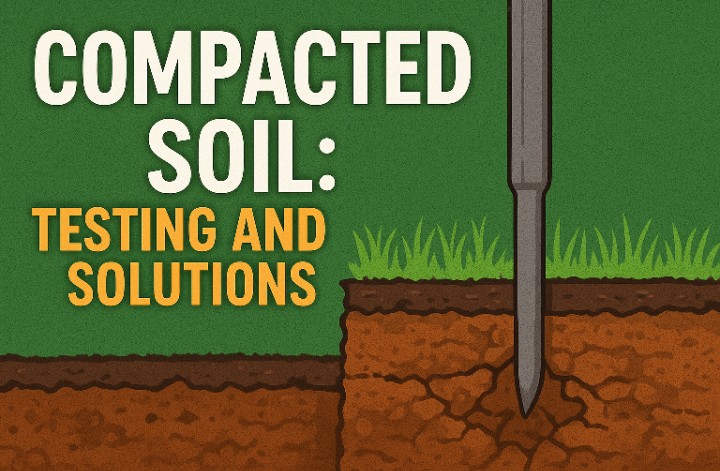
A more quantitative method uses a penetrometer. This device consists of specific components. A pressure gauge mounts at the top of a pointed rod.
You push this rod into soil firmly and steadily. The pressure gauge provides resistance measurements. This shows how hard soil resists penetration.
The pointed tip design is intentional. It represents a plant root. It feels the same resistance that roots encounter.
Push the penetrometer until the gauge reads 300 psi. This is the standard measurement point. Then measure the depth the rod penetrated.
Record this depth carefully. Deeper penetrometer depths indicate less compact soils. Shallower depths mean more severe compaction.
Repeat this process at various locations. Rutgers recommends a minimum of ten measurements per acre. This gives a thorough understanding of soil density.
Other factors contribute to resistance levels measured. Soil texture affects readings significantly. Percent water content matters.
For long-term lawn care programs, track these factors. Knowing soil texture and moisture helps explain resistance levels. Your records become more meaningful over time.
LABORATORY SAMPLE COLLECTION
Professional testing begins with samples. A field technician collects soil after excavation. Experience matters tremendously at this stage.
An experienced technician gathers samples from several locations. This ensures representative samples of various soil types. Different soils may exist on the same site.
Each soil type has different properties. Mixtures behave differently than pure types. A skilled technician recognizes potential properties of each.
They determine the best spots for soil extraction. This requires understanding geology and site conditions. Poor sampling leads to inaccurate results.
Taking a sample from the stockpile can be valuable. Technicians do this when stockpile soil differs from site soil. Or when several soil types get blended together.
PROCTOR COMPACTION TEST
BSK Associates explains the laboratory process clearly. Technicians determine optimum moisture content first. They calculate maximum dry density values.
Lab work starts with sifting and moisture conditioning. Proper preparation is essential for accurate results. Soil must be uniform before testing.
Prepared soil goes into a cylindrical mold. Technicians compact it at various moisture contents. Then they carefully weigh each sample.
The test shows how much material compacts into identical volumes. Dry soil cannot compress very tightly. Adding water improves compaction gradually.
As more water is added, density goes up. But only up to a point. Once material hits its limit, extra water has the opposite effect.
Water starts displacing the material itself. Dry density begins dropping again. This creates a curve shape when graphed.
The peak of this curve is critical. It shows maximum dry density. It reveals optimum moisture for that specific material.
Having an experienced lab is vitally important. Subtle differences in technique affect results. Accuracy requires both knowledge and skill.
NUCLEAR GAUGE TESTING
The final key step uses a soils nuclear gauge. Field technicians bring this device back to the job site. It verifies actual conditions match laboratory predictions.
The nuclear gauge contains two radioactive isotopes. These are roughly the same mass as a pinhead. They emit extremely small amounts of radiation.
Sensors inside the machine detect returning radiation. One source detects hydrogen content. This directly correlates with moisture content.
The other source detects wet density. Both readings work together. The gauge calculates in-place dry density from them.
This calculated number gets compared to lab results. Specifically, to the maximum dry density from testing. Results express as a percentage.
Typical construction requirements range from 90 to 95 percent. Meeting this standard ensures adequate structural support. Failing means more compaction work is needed.
Material changes can drastically affect results. Even slight variations indicate potential failure. An experienced technician notices these changes immediately.
They pull another sample for testing right away. This prevents contractors from wasting time. Working inappropriate material costs money and delays projects.
CORE AERATION FOR LAWNS
Core aeration works wonders for residential lawns. Specialized machines pull plugs from the ground. This is also called aerification.
Rutgers researchers describe the process in detail. Machines typically pull cores one-half to three-quarters inch in diameter. Depth usually reaches three to four inches.
Core aeration leaves most of your lawn intact. It does not destroy the turf like tilling does. Lawn vegetation stays in place throughout.
The process pulls cores completely out of the ground. These cylindrical plugs get left on the surface. You can see them lying on top of the grass.
Breaking up these cores is optional. Many people rake them back into the lawn. Some loose soil falls into the holes naturally. But improved porosity for infiltration and aeration remains.
This method only treats shallow compaction effectively. It cannot reach deep compacted layers. But it rapidly improves topsoil conditions.
With improved growing conditions, everything benefits. Vegetation responds quickly to better air and water. Other organisms’ activity gradually helps loosen soil further.
ROTOTILLING COMPACTED AREAS
Traditional tillage operations work for severe cases. Rototillers break up compacted soil mechanically. This works well for garden beds or renovation areas.
The goal with tillage is specific. Break soil into small clods. Don’t pulverize it into dust. Over-tilling makes problems worse.
Loose soil particles become susceptible to subsequent recompaction. You have actually made the problem easier to recreate. Breaking up is enough. Stop there.
Heavy equipment may be required for severe compaction. But avoid bigger, heavier equipment when possible. The irony is real. You need equipment to fix compaction that equipment caused.
SUBSOILING AND RADIAL TRENCHING
Some situations require deeper intervention. Core aeration only helps the top few inches. Deeper compaction needs different approaches.
Subsoiling penetrates well below typical tillage depth. Specialized equipment breaks up deep compacted layers. This doesn’t bring material to the surface.
Radial trenching helps established trees and shrubs. Crews dig narrow trenches radiating outward from trunks. These create channels to the root zone.
Air and water can finally reach tree roots. The tree responds with improved health and vigor. This technique avoids damaging surface roots.
ADDING ORGANIC MATTER
Whether you use core aeration or traditional tillage, add amendments. Organic matter makes the biggest difference long-term. High-quality compost is your best choice.
Amending soil with organic matter contributes greatly. It helps remediate compacted soil effectively. But more importantly, it prevents future problems.
Organic matter incorporated into soil prevents recompaction. It keeps mineral particles separated. Porosity and drainage stay improved over time.
Organic matter feeds soil organism activity. This maintains the improvements you have made. Structure development continues naturally.
Burrowing earthworms and insects create channels. These act as aeration and drainage pores. They do the work for you automatically.
Exudates from roots and microbes act differently. They work as glues to build porous aggregates. This is opposite to dense clods.
Organic matter has other important benefits. It’s recognized as a major indicator of soil health. Every benefit compounds over time.
HUMATE-RICH AMENDMENTS
For long-term relief from compacted soil, try specialized products. Add humate-rich soil amendments with gypsum. These provide natural aeration that lasts.
Jonathan Green’s Love Your Soil product exemplifies this approach. It loosens hard compacted soil effectively. Root penetration goes up noticeably.
Overall grass growth improves dramatically. The beneficial humates stimulate soil microbes. These break down organic matter naturally.
They convert organic material into nutrients. Grass plants can access these nutrients easily. The entire soil ecosystem becomes healthier.
CALCIUM AND GYPSUM APPLICATION
In cases where soil calcium content is low, gypsum helps. Application of gypsum can build soil structure. But testing first is essential.
Calcium ions act as a bridge. They connect soil particles and start structural development. This builds aggregates and improves porosity between them.
Improved infiltration, drainage, and aeration result. These are exactly what compacted soil lacks. Calcium addresses the root cause.
Test soil to determine if calcium is below optimum. Don’t guess about this. Soil tests are inexpensive and accurate.
If calcium is low and pH is below optimum, apply limestone. Calcium carbonate raises pH while increasing calcium. Use the recommended rate from your soil test.
If calcium is low but pH is within range, choose gypsum instead. Calcium sulfate increases calcium without affecting pH. Apply at the recommended rate from testing.
Gypsum is more soluble than limestone. This suggests water could distribute it through soil. But compacted soil has a permeability problem by definition.
Physical mixing is most effective. Mix gypsum or limestone into soil after breaking up compacted layers. Core aerification or tillage should happen first.
Keep one thing in mind about calcium. If levels are already high or above optimum, gypsum won’t help. It’s not likely to bring noticeable changes.
BIOLOGICAL SOLUTIONS
Top-dressing your lawn with compost provides ongoing benefits. Spread a thin layer once or twice yearly. Rain and irrigation gradually work it in.
Grass grows right through the compost layer. This gentle approach builds soil health steadily. You avoid disruption of major renovation.
Your lawn keeps looking good throughout the process. Improvement happens gradually but surely. This is the sustainable approach.
Earthworm activity becomes critical over time. As soil health improves, earthworms return. Their natural tunneling creates permanent aeration.
Microbial processes contribute similarly. Beneficial bacteria and fungi bind soil particles. They create stable aggregates that resist compaction.
PREVENTING COMPACTION
Prevention should be given high priority. This avoids need for labor-intensive remediation. Long-term fixes take months or years.
Dry soil bears weight better than moist soil. Always avoid loads on wet ground. This single rule prevents most problems.
Keep in mind that heavier equipment causes deeper compaction. Wetter soils make this even worse. Remediation becomes more difficult with depth.
Heavy equipment, including mowers, should be avoided. The length of loading time is important. Shorter exposure causes less damage.
Distributing weight over greater surface area helps. Wide tires accomplish this effectively. Minimal allowable tire pressure reduces ground pressure.
For certain temporary situations, use plywood. Or similar material that spreads loads. This protects soil during short-term heavy use.
An initial trip often does the most damage. But repeated trips make the compacted condition worse. Each pass adds to the problem.
If repeated trips are necessary, control traffic carefully. Use same wheel tracks repeatedly. This keeps total area impacted to a minimum.
Furthermore, with vehicles, avoid fast turns. Don’t spin tires on the ground. This smears soil and further degrades structure.
Where compaction occurs from foot traffic, create diversions. Keep people or animals on paved surfaces. Or accept the path and make it official.
Paving or mulching turns problem areas into features. Permanent pathways handle traffic without harming soil. They can actually improve your landscape design.
MAINTAINING SOIL HEALTH
Annual soil testing should be part of routine maintenance. Test pH at minimum. This tells you whether soil is too acidic or alkaline.
Jonathan Green recommends keeping pH between 6.2 and 7.0. This range suits most lawns perfectly. Grass accesses nutrients most efficiently here.
Add organic matter whenever you can. Compost, aged manure, or leaf mold all work. Even small additions help over time.
Keep monitoring where water flows during rainstorms. Does it run off certain areas instead of soaking in? Those spots likely have developing compaction issues.
Address these problems before they get worse. Early intervention is much easier. Severe compaction takes years to fully remediate.
At Ex Landscaper, we have helped many homeowners with these issues. The key is understanding what’s happening underground. Surface symptoms just point to deeper problems.
BEST PRACTICES FOR HOMEOWNERS
Start by testing your soil in multiple locations. Use the screwdriver or wire flag method. These cost almost nothing but reveal critical information.
Aerate your lawn if you experience traffic stress. This applies especially to play areas and pathways. Annual aeration prevents compaction from building up.
Add compost during or after aeration. This maximizes the benefit of both practices. Compost works down into aeration holes naturally.
Limit traffic on wet grass whenever possible. Make this a household rule. Everyone needs to understand the importance.
Create permanent pathways in high-traffic areas. Don’t fight natural traffic patterns. Work with them instead through good design.
BEST PRACTICES FOR CONSTRUCTION
Construction projects require professional involvement. Conduct laboratory Proctor testing before work begins. This establishes baseline expectations.
Verify field conditions with nuclear gauge testing. Do this throughout the compaction process. Don’t wait until everything is finished.
Meet all regulatory requirements carefully. The 90 to 95 percent standard exists for good reasons. Cutting corners creates long-term problems.
Test multiple locations throughout the site. Soil types often vary even on small properties. Each type needs individual testing.
Document all results thoroughly. Keep records of every test. This protects everyone if problems arise later.
LONG-TERM SUCCESS STRATEGIES
Combine mechanical and biological solutions for best results. Aeration or tillage provides immediate relief. Organic amendments ensure lasting improvement.
Regular monitoring catches problems early. Walk your property after every significant rain. Look for standing water or runoff issues.
Protect your landscaping investment through prevention. Avoiding compaction is easier than fixing it. Smart management keeps soil healthy indefinitely.
Work with experienced professionals when needed. Some situations go beyond DIY capabilities. Knowing when to seek help saves time and money.
KEY TAKEAWAYS
Identify compaction early through visual signs and simple tests. The screwdriver and wire flag methods cost almost nothing. They provide reliable preliminary information.
Use appropriate testing methods based on your needs. Homeowners can handle basic testing themselves. Construction projects require professional laboratory and field verification.
Combine solutions for maximum effectiveness. Mechanical remediation breaks up compacted layers. Organic amendments prevent the problem from coming back.
Focus on prevention above all else. Avoid heavy loads on wet soil. Control traffic patterns. Use proper equipment and techniques.
Maintain soil health through regular testing. Keep organic matter levels high. Monitor pH and adjust as needed. Healthy soil resists compaction naturally.
Seek professional help for severe compaction. Also for construction-related projects. Experience and proper equipment make a huge difference. Don’t hesitate to call experts when situations warrant it.