
Early Weed Prevention: Stop Crabgrass Before It Starts: 95% Effective Pre-Emergent Method
Your Complete Guide from Ex Landscaper
What Happens When You Ignore Crabgrass
Think, You wake up one morning and walk outside. Your lawn looks fine. But by mid-summer? It’s covered in thick patchy clumps. That ugly invader is crabgrass prevention target. The worst part? It was completely preventable.
Crabgrass is a summer annual weed. It grows fast. It spreads seeds by the thousands. And it loves thin stressed lawns. Once it takes over a patch of grass it pushes out everything around it. Zone 5/6 crabgrass timing is critical here.
Here at Ex Landscaper we have seen this happen to so many homeowners. The good news is that stopping crabgrass before it starts is actually simple. You just need the right timing and the right tool.
What Is Crabgrass and Why Does It Spread So Fast
Crabgrass belongs to the grass family called Poaceae. It lives for just one season. But in that one season it does a lot of damage.
According to Penn State Extension crabgrass seeds start germinating in spring. They keep sprouting into early summer. Then the plant grows through summer and produces seedheads from July through September. Each plant can drop thousands of seeds before frost kills it in fall [Penn State Extension].
Those seeds sit in your soil all winter. Come next spring? They start all over again. That’s the cycle you are fighting.
Crabgrass loves lawns that are thin or stressed. Cool-season grasses like Kentucky bluegrass and fescue in USDA zones 3 to 7 are especially at risk. If your turf has bare spots or thin areas crabgrass will find them first. Prodiamine granular application rate helps here. [Cornell CALS]
When Does Crabgrass Actually Start Growing
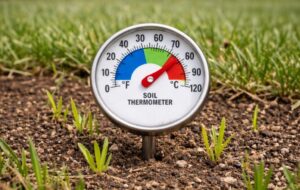
Timing is everything with crabgrass. It does not just pop up randomly. It waits for a specific trigger. Purdue Extension research shows that crabgrass germinates when soil temperatures hit around 60 degrees F for 3 to 5 days straight [Purdue Extension]
Rutgers University data shows that seedling emergence usually starts in late April in the Northeast. It peaks in May before slowing down in summer. Purdue historical records show the average germination date around April 29 in Fort Wayne Indiana.
Penn State Extension puts the trigger at 55 to 58 degrees F at daybreak at the one inch soil depth. Once that threshold holds for 4 to 5 days seedlings start pushing up.
So what does this mean for you? It means you need to act before your soil warms up to that point. Not after. Not when you see the weeds. Before.
How Does Pre-Emergent Herbicide Work
A pre-emergent herbicide does one job well. It creates a chemical barrier in your soil. When crabgrass seeds try to sprout that barrier stops them cold. The seedling can’t break through.
This is not the same as a post-emergent product. Pre-emergent stops seeds from sprouting. It does nothing to weeds that are already growing. That’s a key difference to understand.
Research from Purdue Extension shows these products can be applied as early as March 1 and still stay effective. They generally remain active in soil for 60 to 120 days depending on the product.
Applied at the right time you can expect up to 95% crabgrass control. That’s not a small number. That’s most of your lawn protected for the whole season. [UMN Extension]
Top Pre-Emergent Products:
– Barricade – Active Ingredient: Prodiamine, Coverage: 90-120 days, Best For Long season [Colorado State Extension]
– Dimension – Active Ingredient: Dithiopyr, Coverage: 60-90 days, Best For: Early post-emergent
– Pendulum – Active Ingredient: Pendimethalin, Coverage: 60-90 days, Best For: Granular ease
When Should You Apply Pre-Emergent Herbicide
Penn State Extension recommends applying 10 to 14 days before the earliest expected crabgrass germination in your area. That usually means mid-spring before forsythia flowers drop.
A simple trick is to use a soil thermometer app like Soil Temp. When your soil average hits 50 to 55 degrees F start thinking about applying. Dont wait for 60 because by then it may be too late.
For season-long protection Penn State research supports a two-application approach. Apply first in early spring. Then add a second application 6 to 8 weeks later. Groundhog Turf notes that overlapping applications give you the best overall coverage.
Pro Tip: Check [Penn State Extension Crabgrass Timing Tool].
Which Products Work Best for Crabgrass Prevention
Colorado State Extension lists the most common active ingredients as pendimethalin, prodiamine, dithiopyr, benefin/trifluralin, and oxadiazon.
Penn State Extension identifies three standout performers. Prodiamine sold as Barricade. Pendimethalin sold as Pendulum and Pre-M. And dithiopyr sold as Dimension. These have shown strong long-term preemergence control in university studies.
Prodiamine is popular for a reason. According to LawnPhix it can provide a protection window of up to nine months. It’s preemergent only so you want to apply before germination.
Dithiopyr is a bit more flexible. Central Pros notes that dithiopyr works as both a pre-emergent and an early post-emergent specifically for crabgrass. So if you miss the window slightly it still has some power.
Both granular and liquid forms are available. Granular is easier for most homeowners. Liquid spreads more evenly but requires more equipment.
Learn More: [Prodiamine vs Dithiopyr Full Comparison]
How to Apply Pre-Emergent Step by Step
Start in late winter. Aerate any compacted areas. Overseed thin spots with crabgrass-resistant grass like tall fescue. A dense lawn is your best long-term defense.
Choose your product based on your lawn size and needs. Pick up prodiamine, dithiopyr, or pendimethalin from a garden center or online.
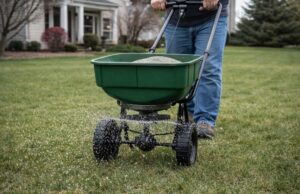
Apply in mid-spring before soil temperatures hit the germination threshold. Use a broadcast spreader for granular products. Apply at the label-recommended rate. Penn State Extension says to water it in within 2 to 3 days of application using about a half inch of water.
Six to eight weeks later add your second application. This keeps your barrier strong through the peak germination window and into early summer.
Wear gloves when applying. Avoid windy days so the product stays where you put it. Keep kids and pets off the treated area until it’s fully dry.
Mowing Height Makes a Huge Difference
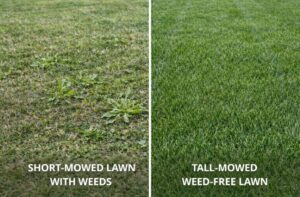
Here’s something most people overlook. How high you mow directly affects crabgrass pressure. Michigan State Extension recommends raising your mower to 3.5 inches. Taller grass shades the soil and blocks sunlight from reaching crabgrass seeds.
A study from NC State University showed this clearly. Fescue mowed at just 1 inch had 95% crabgrass cover by mid-September. Mowed at 4 inches? Zero percent. That’s a massive difference with just one setting change.
Purdue Extension puts it simply. Mowing high and encouraging dense turf are the most effective crabgrass prevention strategies you can use. Pre-emergent herbicide works even better when your grass is already thick and healthy.
Watering and Fertilizing the Right Way
Deep infrequent watering beats frequent shallow watering every time. House Digest explains that overwatering keeps grass roots near the surface. Shallow roots mean weak grass. Weak grass means more crabgrass opportunity.
Aim for about 1 inch of water per week. Water less often but more deeply. This pushes grass roots down and makes your turf harder for weeds to invade.
For fertilizing use a slow-release nitrogen product in spring. It strengthens your turf without creating a nutrient spike that feeds weeds. Avoid excessive nitrogen applications. More is not always better.
Overseed every fall. A thick lawn in spring leaves little room for weed seeds to find bare soil. Dense turf is the best weed barrier nature provides.
Our Common Mistakes That Let Crabgrass Win
The biggest mistake is waiting until you see crabgrass before acting. NutriGreen says it clearly. By the time crabgrass is visible pre-emergent is no longer the right tool. The window has closed.
Applying too early is also a problem. If you apply in January in a mild climate the product breaks down before germination even starts. Check your local soil temperatures.
Not watering it in is another common error. Many pre-emergent products need moisture to activate and form that soil barrier. Without water they sit on top and do very little.
Disturbing the soil after application breaks the barrier. If you rake or aerate heavily after applying you have created gaps in your protection.
House Digest also points out that contaminated mulch or topsoil can bring crabgrass seeds right into your lawn. Be careful about where your landscape materials come from.
Can You Use Pre-Emergent on a New Lawn
No. Most pre-emergent herbicides will stop your new grass seed from germinating too. They can’t tell the difference between crabgrass seeds and the grass you planted.
Purdue Extension recommends waiting 6 to 8 weeks after seeding before applying most products. Penn State Extension confirms that pre-emergents have long residual activity that can harm newly seeded turf.
There is one exception. A product called Siduron lets cool-season grasses germinate while still blocking crabgrass. If you need to seed and prevent crabgrass at the same time that’s your best option.
Is Pre-Emergent Herbicide Safe for Pets and Kids
Most pre-emergent products are safe once dry. That usually takes 24 to 48 hours depending on weather and product. Read the label carefully because it has the exact instructions for your specific product.
Penn State notes that pre-emergents have long residual activity in the soil. The key is following the label directions for application rates and re-entry times. When in doubt keep everyone off the lawn for a couple of days.
What About Organic Options for Crabgrass Control
Corn gluten meal is the main organic alternative. University greenhouse testing shows it can achieve 50 to 66% crabgrass suppression. That’s decent but not close to the 90 to 95% you get from chemical pre-emergents.
Corn gluten meal also takes consistent use over 2 to 3 years to build up effectiveness. Apply around 20 pounds per 1000 square feet. It’s a good fit for homeowners who prefer chemical-free lawns and are willing to be patient.
Organic vs Chemical: Corn gluten = 50-66% control vs Prodiamine = 95% control.
What If Crabgrass Is Already Growing
If crabgrass has already sprouted pre-emergent won’t help. You need a post-emergent product. Quinclorac is a strong choice here.
Quinclorac provides excellent control of crabgrass at almost any growth stage. It also has the added benefit of boosting broadleaf herbicide activity when used together with those products.
Catch it young if you can. Small seedlings are easier to kill than mature plants. Once crabgrass starts producing seed heads you are in a much harder fight.
FAQ
When to apply pre-emergent for crabgrass in Zone 5/6?
– Apply 10-14 days before soil hits 55-58°F (around 50-55°F trigger). Two apps 6-8 weeks apart.
Prodiamine vs Dithiopyr for crabgrass?
Prodiamine: 90-120 days pre-emergent only. Dithiopyr: 60-90 days + early post-emergent.
What soil temperature triggers crabgrass germination?
-55-60°F for 3-5 consecutive days at 1-inch soil depth.
Can pre-emergent be used on new lawns?
– No, wait 6-8 weeks after seeding; use Siduron as exception.
Is mowing high effective against crabgrass?
– Yes, 3.5-4 inches shades soil, reduces crabgrass up to 95%.
What if crabgrass is already growing?
– Use post-emergent like quinclorac on young plants.
The END
Crabgrass is a problem you solve in spring not summer. The whole strategy is simple. Know when your soil warms up. Apply a pre-emergent before it hits 55 to 60 degrees F. Water it in. Mow high. Water deep.
Check your soil temperature this week. If you’re in a zone where spring comes early you may already be close to the window. Don’t wait another season to regret it.
At Ex Landscaper we believe the best lawn care advice is the kind that actually works for real homeowners. You don’t need a complicated routine. You need the right information at the right time. Now you have both. Okay, Thanks for reading and if you have any question just comment bellow. Bye
Read More: Exlandscaper