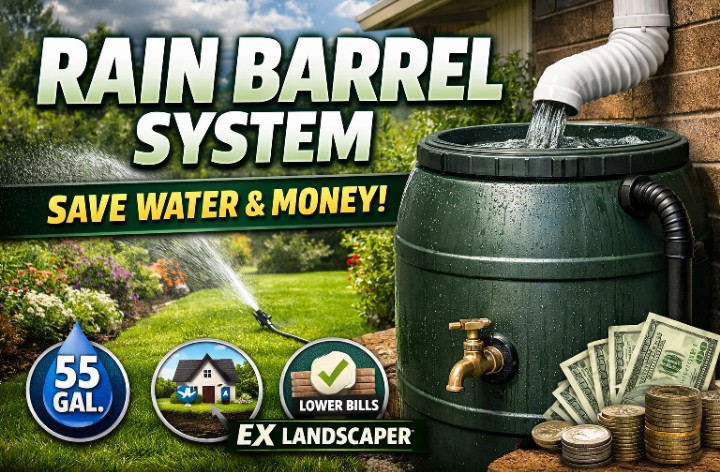
Is your water bill going up every summer? You are not alone. Millions of homeowners across the US watch their lawn dry out while their utility bills keep climbing. But here is the thing every time it rains, hundreds of free gallons are flowing right off your roof and straight into the storm drain. That’s wasted money. And it does not have to be.
A rain barrel system is one of the simplest upgrades you can make to your home. It collects rainwater from your roof. You store it. Then you use it to water your lawn and garden when you need it most. Here at Ex Landscaper, we talk a lot about working smarter in your yard and this is one of those classic moves that just makes sense.
Yes, Rain Barrels Actually Save You Real Money
Let’s talk numbers first. That’s what matters most to any homeowner.
The average homeowner can save up to 1,300 gallons of water each year by using a rain barrel. Salemnh That can reduce your water bills by 20–30% roughly $50–100 per year. A 55-gallon collection tank saves you around $30–60 per month during peak growing season when outdoor watering is at its highest.
Honestly? That adds up fast over a full summer.
The EPA estimates that about 30 percent of daily household water use happens outdoors. That’s where the hit is. A rainwater harvesting setup directly cuts into that cost without you doing anything extra.
Here’s What Rainwater Actually Does for Your Lawn
Tap water is treated. It contains chlorine, fluoride, and added minerals. Your grass tolerates it. But it does not love it.
Rainwater is free from chlorine, fluoride, and the minerals found in treated tap water. Your plants will literally look more vibrant. Pro Tools Guide
That’s chemistry, not marketing. Soft rainwater absorbs into soil more easily. No mineral buildup in your drip lines or soaker hoses. Your lawn roots get a genuinely cleaner drink. And here’s the bonus using recovered rainwater for landscaping helps conserve potable water and reduces stormwater runoff. World Wildlife Fund You are helping your yard and your neighborhood at the same time.
How Much Free Water Can You Collect Each Rain?
More than most people expect.
The average roof collects 600 gallons of water for every inch of rain. You wont catch all of it from one container. But even directing one downspout into a single collection tank makes a real dent. A home with outside dimensions of 27 x 37 feet can potentially collect 720 gallons per inch of rainfall. HGTV
Think about that the next time it rains.
A single 50-gallon barrel fill waters a 200 square foot vegetable garden for three days. Lexave Brew Got a bigger lawn? Linking two or three units together is the obvious next step.
Read more: Stop Crabgrass Dead Best Organic Pre-Emergent Alternative for Lawn
How to Pick the Right Rain Barrel for Your Yard
Walk into any home improvement store and the options feel overwhelming. Here is a simple way to think it through.
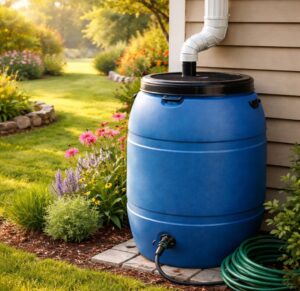
Size: A 55-gallon barrel is a standard starting point, but you can easily expand by connecting multiple barrels in series. Mossy Street One unit works fine for container gardens. A full lawn setup needs more storage.
Material: Go with food-grade HDPE plastic. It’s the most common and affordable option at $30 to $80. Wooden whiskey barrel styles cost $80 to $150. Avoid barrels that previously held chemicals. D and G Flooring
Features: Look for a debris screen on top, an overflow port, and a spigot near the bottom. The flow rate decreases as the barrel empties. Elevating the unit improves water pressure. Lowe’s
Cost: Most homeowners spend an average of $140 for a 40 to 60-gallon barrel. LawnLove Many local municipalities offer rebates that bring this down further. Worth checking before you buy.
Latest 2026 Rain Barrel Trends and Top Picks
The market has changed a lot recently. Newer systems look better, link together easily, and some even connect to your phone. Here’s what’s popular right now.
If you want something built for lawn irrigation, the RTS Home Accents 50-gallon is a solid choice. It runs $130–150, comes with a brass spigot, and the UV-resistant plastic holds up through multiple seasons without fading or cracking. [According to hands-on testing at Lexave Brew, a single fill from this barrel waters a 200 sq ft garden for three full days.
New to rainwater harvesting? The FreeGarden RAIN 55-gallon is built for beginners. It’s priced between $120–160 and includes everything you need to get started right out of the box. No extra trips to the hardware store.
Got a smaller yard or tight space? The EarthMinded RainStation 45-gallon fits well in compact spots and comes with a mosquito-proof lid built in. It runs around $140 and is easy to tuck next to a downspout without taking up much room.
The newest category worth knowing about is smart modular systems with IoT monitoring. These run $200 and up. They are pricier but let you track your water collection data straight from your phone. Bob Vila’s 2026 rain barrel guide covers several of these connected options in detail if you want to dig deeper.
The big 2026 trend? Modular and linkable setups. Start with one unit. Add more onto the overflow port as your needs grow. No need to replace anything.
Read more: Sustainable Lawn Resolutions 2026 Guide to an Eco Friendly Yard
Is Collecting Rainwater Legal in the US?
Good question. And yes most states are fine with it.
Most US states now allow residential rainwater collection for outdoor use. Rules do vary by location though. Before buying anything, check your local guidelines via the EPA website or your state’s environmental department. Five minutes of research now saves a real headache later.

How to Install a Rain Barrel Step by Step
Good news this is a genuine weekend project. Most homeowners wrap it up in under an hour.
Step-1: Choose your spot
Position the collection tank directly under a downspout that drains the largest section of your roof for maximum capture. Level ground is non-negotiable here.
Step-2: Build a solid base
Place the unit on a raised platform two or three stacked cinder blocks or a purpose-built wooden stand to increase water pressure at the spigot. A full 55-gallon barrel weighs about 460 pounds so the platform must sit on level compacted ground.
Step-3: Connect the downspout
Draw a line on the downspout 9 inches above the top of the barrel. Cut at that line with a hacksaw. Crimp the end so the elbow fits over it. Attach the elbow and position the barrel so the elbow sits over the center of the lid.
Step-4: Manage the overflow don’t skip this
A 55-gallon tank fills completely from just 0.1 inches of rain on a 1,000-square-foot roof section. Without overflow management water pours over the top and pools against your foundation. Route the overflow hose at least 4 to 6 feet away from your house.
Step-5: Screen the opening
Use fine fiberglass window screen to keep out mosquitoes and leaves. Most modern units come with this already. If yours does not, cut a piece to fit and secure it tight.
Step-6: Run a leak test
Test the system for leaks using a garden hose before the first rainfall. Make sure the overflow points the right direction. Done
Linking Multiple Units for Bigger Lawns
One tank is a solid start. But bigger yards need more storage. The fix is simple.
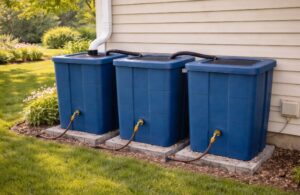
Several rain barrels can be linked together in an easy 5-minute setup. Wachusettearthday The first tank fills completely then water transfers to the second through the overflow port. Double the storage. Same amount of work.
Most residential systems start with 50 to 60 gallons but daisy-chaining allows you to store hundreds of gallons for use during dry spells. Utilitiesformyhome That matters a lot when drought restrictions kick in and your neighbors are scrambling.
Keeping Your Collection System Running Smoothly
Maintenance is genuinely light. But a few habits matter.
Clean the debris screen every month. Check that lids and hoses are properly placed, hardware is functioning and no yard pests have found an entrance into the system.
Seeing mosquito activity? Mosquito dunks are biodegradable tablets containing a naturally occurring bacterium that kills mosquito larvae in standing water without harming pets, fish, wildlife or humans. UGA Extension Drop one in Problem solved.
Winter is coming? Don’t ignore it. Empty or drain your rain barrel before storing for the winter. When possible store it in a protected indoor area. If it must stay outside turn it upside down and secure it. Frozen water expands and cracks plastic. A drained tank lasts for years.
Can You Drink Rain Barrel Water? Straight Answer
No. Full stop.
According to the CDC rainwater collected from your roof should only be used for non-potable tasks like watering lawns, washing cars or ornamental gardening. Roofing materials and bird droppings contaminate it along the way. Great for your grass. Not for your glass.
FAQs
Do rain barrels actually work for lawn irrigation?
Absolutely. They provide plants with naturally soft water free of chlorine and fluoride, reduce stormwater runoff that can damage foundations, and give you a backup water source during drought restrictions. Lexave Brew
How fast does the tank fill up?
Fast, A 55-gallon unit fills in about 20 minutes during moderate rainfall from a typical residential downspout. Heavy storms? Even quicker. That’s exactly why overflow management isn’t optional.
When does it pay for itself?
Rain barrels pay for themselves in about one year through water bill savings. Everything after that is free water.
Read more: Building Soil Biology Naturally: A Wiley Western Homeowner Guide
The END
A rainwater harvesting system is one of the smartest low-cost moves any homeowner can make. No contractor needed. No complicated setup. Just free water from every rainfall working for your lawn instead of running down the drain.
Your grass gets softer water. Your bills go down. Your foundation stays protected from runoff. And you’re ready when summer drought restrictions hit.
Set it up this weekend. Your future self will be glad you did. Thanks for reading. Bye bye