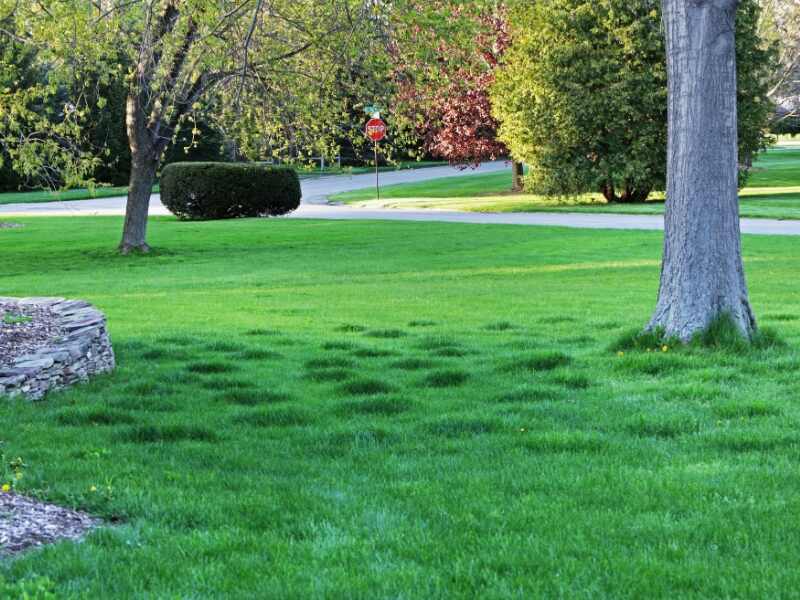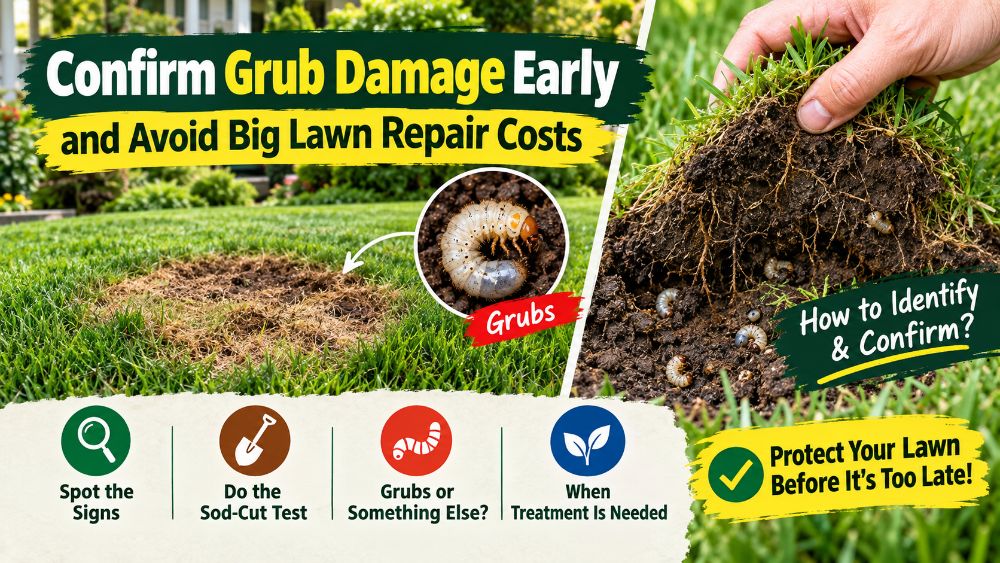
Irregularly shaped brown patches suddenly appear on your lawn and you wake up one morning to find the soil dug up. Even though you water properly, the grass is not getting healthy. This could be the work of grubs. But suspicion alone is not enough. Confirming is important because the same symptoms can have other causes too. In this entire article, I will show you how to identify grubs, how to confirm them and how to tell whether the problem is actually grubs.
What Grubs Actually Are

According to Illinois Extension, grubs are the larval stage of various species of beetles and chafers. Japanese Beetles generally lay their eggs in mid-summer, in sunny, regularly watered lawns. These larvae stay underground and eat the grass roots, which gradually weakens the grass above. UNH Extension adds that healthy grass can tolerate some grub feeding, and that all grass is able to withstand a certain amount of grub feeding.
Signs to Look For
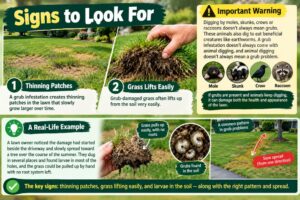
According to UNH Extension, a grub infestation creates thinning patches in the lawn that slowly grow larger over time. During this time, it is often seen that grub-damaged grass lifts up from the soil very easily.
An important warning: The same source states clearly that many people think digging by moles, skunks, crows or raccoons confirms a grub problem but this is not a reliable signal. A grub infestation does not always come with animal digging and animal digging does not always mean a grub infestation. These animals also dig to eat beneficial creatures like earthworms. However, if grubs really are present and animals keep digging to find them, this can damage both the health and the appearance of the lawn.
A real-life example: In a question sent to an Extension office, a lawn owner said the damage to their lawn had started beside the driveway and slowly spread toward a tree over the course of the summer. They dug in several places and found larvae in most of the holes, and the grass could be pulled up by hand with no root system left. The Extension’s advice was that grass that comes up this easily without roots generally indicates grub damage. This slow spread from one particular direction is, in many cases, a familiar form of a grub problem.
How to Confirm

According to UNH Extension’s advice, use a spade or lawn edger to cut out a section of about one square foot in the suspicious area, then lift that piece of grass and soil and look at it. If there is truly significant grub damage, the grass will come up relatively easily. Then examine the soil carefully and count the grubs. Finding 10 or more larvae per square foot is considered a serious infestation but finding a few larvae is normal and not a cause for concern. After the check, put the cut piece back in place as quickly as possible so that the lawn suffers no extra damage. If the lawn is large, it is better to do this test in multiple places, because the result from one spot cannot tell you for certain the condition of the whole lawn.
Grubs or Some Other Problem
UNH Extension gives an important piece of information: many lawn problems can look like grub damage, such as disease, drought stress, hairy chinch bugs, sod webworms, shade and soil compaction. After snow melts in spring, people often mistakenly think it is the work of grubs, even though the real cause may be different. So it is not right to make a decision based only on visible symptoms.
- If you see circular brown patches on the lawn, especially with white mycelium in the early morning, it could be a fungal disease. To learn more, read our Brown Patch article.
- And if the problem is limited to a particular shaded area, or appears in a striped/random patch pattern, it could be uneven growth caused by shade, soil texture, or irrigation. To learn more, see Uneven Grass Growth.
The sure distinguishing signs of grubs are grass lifting easily in the sod-cut test and larvae found when counting in the soil. The other causes do not show this.
Another common mistake that can be avoided: Sometimes, seeing circular brown patches on a neighbor’s lawn, a person assumes their own lawn’s problem must have the same cause, grubs. But if you do the sod-cut test, you may find there are no larvae in the soil, and instead you notice a white coating on the grass in the early morning. Then it becomes clear that the real cause was a completely different problem. That is why I say it is not right to assume the same cause just because things look similar. For this very reason, it is important to follow the comparison list above and the confirmation method.
When Treatment Is Needed
According to UNH Extension if 10 or more grubs per square foot are found, treatment may be needed to maintain healthy grass. However if the grub count is lower than this yet the lawn still looks bad, that is an indication that the problem may be related to broader lawn-care practices, not just grubs. In this case, UNH Extension advises testing the soil regularly, keeping the grass at least two to three inches tall (so that the root system is deep and resilient), and reseeding bare spots regularly.
An important nuance about Milky Spore: It is known as a common organic solution and according to UNH Extension it can be effective against Japanese Beetle larvae, but on one condition: the spring soil must be warm enough. In cooler regions (such as northern New England), spring soil is generally not warm enough for this to work, so it may not be effective there, although some evidence of effectiveness has been found in warmer microclimates. So, in my opinion, it is not right to oversimplify and say “Milky Spore is always ineffective.” It depends mainly on the region and the grub species, and results also take several years to appear.
Nematodes are a second natural option: According to UNH Extension nematodes are microscopic worms, and some species can work well for controlling grubs in home lawns. However, to use them successfully, several conditions must be met: the lawn must be kept thoroughly wet and the soil must not be allowed to dry out while the nematodes are establishing; the nematodes must be alive at the time of application (so they should be bought from a reliable supplier and applied quickly) and the right species must be applied at the right time. Nematodes are sensitive to light and can die in intense direct sunlight within a minute, so I think it is best to apply them on a cloudy day or in the morning. For curative use, application may be needed every two weeks, and for preventive use, two to three times a season. If you follow the instructions properly, this can be an effective natural option.
What to Do After Treatment
If any part of the lawn becomes completely bare because of grubs, that area may need to be reseeded after treatment. For the detailed step-by-step method of how to reseed properly, see our Reseed Bare Patches article.
FAQ
Does seeing dug-up soil confirm a grub problem?
No, According to UNH Extension, moles, skunks, crows or raccoons also dig to eat other insects (such as beneficial earthworms). A grub infestation is not always accompanied by animal digging and digging does not always mean grubs are present.
How many grubs are a cause for concern?
Finding 10 or more grubs per square foot is considered a serious infestation. Finding fewer than this is normal and there is not much cause for concern.
Does Milky Spore work on all grubs?
No, and it does not work equally well everywhere either. It can be somewhat effective only on Japanese Beetle larvae and only when the spring soil is warm enough. In cold regions, its effectiveness is limited.
Is using nematodes safe and easy?
Fairly safe but not easy. To make it work properly, you must meet several conditions, such as the right species, the right timing, adequate moisture and avoiding direct sunlight. If these conditions are followed properly, it can be an effective option.
Conclusion
The most reliable way to identify grub damage is the sod-cut test. Decisions should not be made just by looking at brown patches or dug-up soil, because the same symptoms can also come from disease, shade, or irrigation problems. If you confirm first and then take action, the problem is easiest to bring under control.