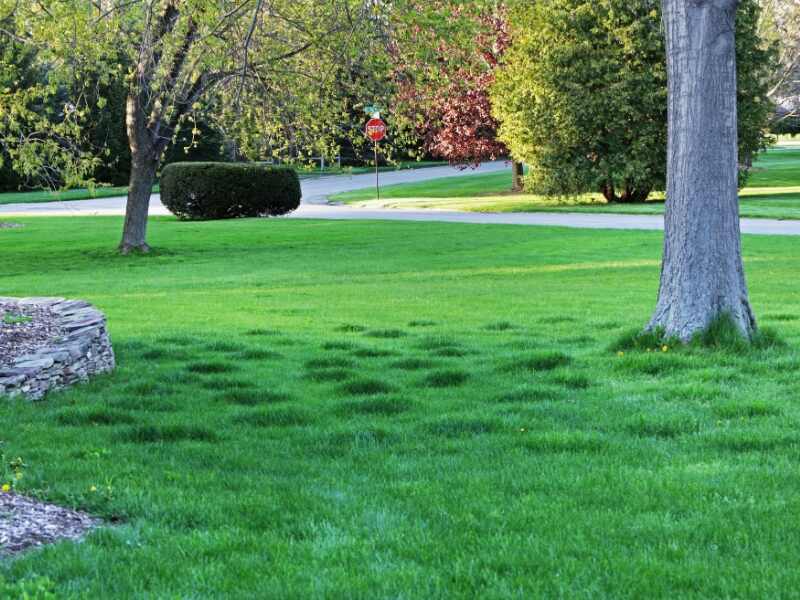
Your lawn might not have any spots where grass is completely missing but it still looks messy — dense and green in some areas, thin or pale in others. This might seem like a bare-spot or dead-grass problem but it isn't — it's an inconsistency in growth. In this article, we will look at why this happens and how to identify the actual cause.
Reasons Your Lawn Grows Unevenly
Uneven Fertilizer Application (Striping)
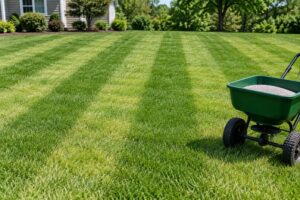
According to Penn State Extension, incorrect overlap or skips during spreader use creates light and dark green striped patterns in the turf and can also lead to inconsistent pest control or leaf burn in places. As a fix, they recommend making two coverage passes — with the second pass at a right angle to the first, so the grid pattern created covers up any skips or overlaps.
Michigan State University Extension confirms the same thing, noting that uneven nitrogen application creates light and dark green stripes that follow the spreader’s path. Regular spreader calibration and maintaining proper overlap distance can prevent this.
Sprinkler or Irrigation Coverage Gaps
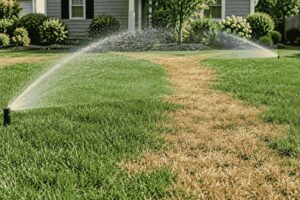
According to the University of Nebraska–Lincoln, nearly every irrigation system has some degree of gap or overlap. A well-designed system should have “head-to-head coverage” — water from one sprinkler head needs to reach the next head, because more water falls near the head itself and less at the outer edge, so even distribution isn’t possible without overlap. Where this coverage isn’t achieved properly, the grass turns brown or dry there, creating a visible contrast with the surrounding green grass. You can identify this issue by pushing a screwdriver into the soil and comparing wet versus dry spots.
Mowing Pattern and Scalping
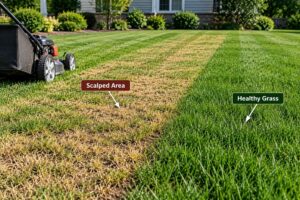
According to New Mexico State University Extension, scalping — cutting the grass shorter than necessary — can damage or kill turf during periods of stress. Since recovery takes time, weeds can move into these areas in the meantime, creating visibly inconsistent patches across the lawn.
Variation in Soil Texture
According to the University of Delaware Extension and North Dakota State University Extension, soil texture (clay, silt, sand) determines how prone it is to compaction — clay or silty soil compacts relatively easily. If soil texture varies across the same lawn, root growth and the ability to take up water and nutrients also vary, creating inconsistencies in growth. Mixing in compost or other organic matter is recommended as a fix adding sand is discouraged, since it can create a concrete-like, hardened structure.
Variation in Sunlight or Shade
If one part of your lawn sits in the shade of a tree while the rest gets full sun, you will see a clear difference in grass density and color between the two areas. For the detailed causes and fixes for why grass thins out or pales in shaded areas, see our Why Does Grass Die in Shade? article.
How I Identify the Real Cause
I start by carefully observing the pattern. Paying attention to the pattern can tell you a lot too — a striped pattern usually points to fertilizer or mowing issues, while a scattered or random patch points toward soil or light variation. To confirm the problem in a specific spot, you can use the screwdriver test as recommended by UNL Extension — comparing dry and wet areas makes irrigation-related causes easy to spot.
Keep in mind, this is different from circular brown patches or completely bare areas. If you see distinct circular brown spots on your lawn, that might be a specific fungal disease called Brown Patch — feel free to read the full article for identification and treatment steps.
General Guidance for Fixes
- For fertilizer: Calibrate your spreader regularly and apply in two crosswise passes so any overlaps or skips get covered.
- For irrigation: Check sprinkler head spacing and coverage and make sure each head’s water reaches the next head.
- For mowing: Keep blades sharp and follow the rule of never removing more than one-third of the grass blade at once — try to avoid scalping.
- For soil: In areas with heavier compaction, mix in compost or organic matter to improve the texture.
When This Can Turn Into a More Serious Problem
Left unaddressed, areas of uneven growth commonly weaken over time and can turn into genuine bare spots or become more susceptible to turf disease while weak. And if an area has already gone completely bare, see our guide to reseeding bare patches for the detailed step-by-step method to reseed it.
Conclusion
Uneven lawn growth is not usually a major disaster — in most cases, it comes down to identifiable causes like fertilizer application, irrigation coverage, mowing practices, soil texture or variation in light. And in my view, once you spot the pattern and pin down the right cause, the fix tends to follow easily. Okay boss thanks for reading and if you have any question you just comment bellow, bye bye