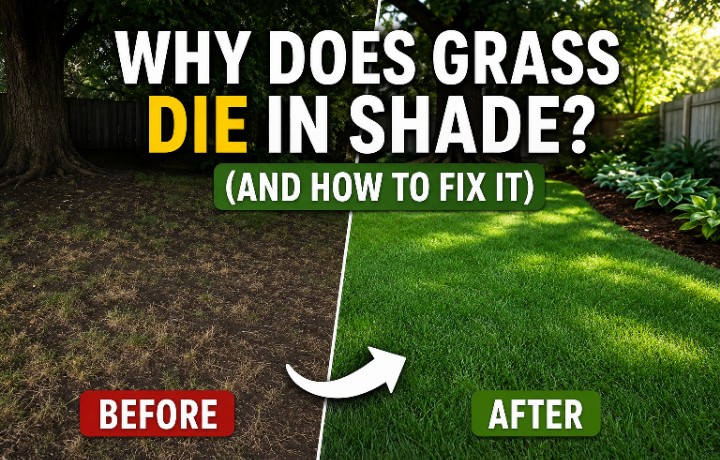
You plant grass seed under the big oak tree. Waters it… Waits, A few weeks later thin, patchy, dying. You try again next spring. Same result…
It feels frustrating. But the thing is: it’s not bad luck. And it’s not just the shade. There are usually four or five things working against your grass at the same time. Once you know what they are, the fix becomes a lot clearer.
This guide breaks it all down why shaded grass dies, how to figure out your specific problem and what you can actually do about it.
Grass Is a Sun Plant That’ s Just Biology
Before anything else it helps to understand what grass actually is. Turfgrass did not evolve in forests. It came from open savannahs and plains wide, sunny places with almost no tree cover. So when you put it under a dense canopy, you are placing it in an environment it was never built for.
Every grass plant needs sunlight to run photosynthesis the process that turns light into sugar and energy. That energy keeps the plant alive 24 hours a day, even at night when no photosynthesis is happening. In shaded spots, photosynthesis slows down. The plant starts burning through its stored energy faster than it can replace it. Eventually, it runs out. That’s when you see it thin out and die.
The general rule of thumb: if a spot gets less than 4 hours of direct sun per day, most grass types will struggle to survive there long-term. The University of Maryland Extension puts the ideal minimum at 6 hours of direct sunlight for turfgrass to stay healthy.
Shade Alone Is not the Whole Story
Most people think it’s just the low light. But that’s rarely the only issue. In most yards, shaded areas come with a whole set of extra problems and they all hit the grass at once.
The Light That Reaches Shade Is the Wrong Type
This one surprises a lot of people. It is not just that there is less light under a tree, the quality of that light is also different.
Sunlight has different wavelengths. Grass needs blue and red light for photosynthesis to work properly. But when light passes through a tree canopy, the tree absorbs most of the useful wavelengths for its own growth. What reaches the grass below is mostly far-red light, the kind that’s far less useful for photosynthesis.
This imbalance triggers a stress response in grass. The plant produces too much of a hormone called gibberellic acid, which makes it grow tall and spindly instead of thick and rooted. Cell walls get thinner. Roots get shorter. The grass becomes physically weaker and far more vulnerable to disease and foot traffic.
Tree Roots Take the Water and Nutrients First
You might think fertilizing will help. It often does not because the tree gets there first.
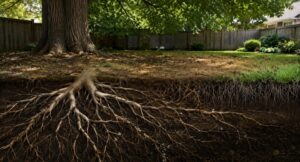
Large trees have root systems that spread well beyond their canopy. Those roots are actively pulling water and nutrients from the soil all around them. Even if you water and fertilize regularly, your grass is competing against a much bigger plant with a much bigger root system. And it loses most of the time.
This is why you will sometimes see grass die in patches that extend past the shade line. It is not just shadow it is underground competition.
Some Trees Actually Release Chemicals That Kill Grass
This is called allelopathy when a plant releases chemicals that suppress or harm other plants nearby.
The most well-known example is black walnut. It releases a chemical called juglone from its roots and fallen leaves. Grass near a black walnut often turns yellow, wilts and dies even in areas that get decent sunlight. If you have a black walnut in your yard and can not figure out why nothing grows underneath, juglone is almost certainly the answer.
Maple and sweet gum trees are also worth watching. Leaf litter from these trees can build up as a thick layer of organic matter that physically blocks grass from growing. According to the University of Missouri Extension, grass is generally easier to grow under locust and poplar trees compared to dense-canopy trees like maples.
Fungal Disease Moves In Quietly
Shaded areas are wet, humid and still. That’s exactly what lawn fungus loves.
Powdery mildew is the most common one. It shows up as a white or grayish dusty coating on grass blades almost like someone sprinkled flour on the lawn. It thrives in spots with poor air circulation, low light and high humidity. Kentucky bluegrass is especially prone to it in shaded areas.
Other diseases like leaf spot, brown patch and rust also show up more often in shade. They dont always kill the grass outright but they weaken it steadily over time. A lawn that’s already struggling with low light does not have much left to fight back with.
Fallen Leaves Smother New Growth
In fall, a thick layer of leaves lands on already-thin grass. For established turf, this is manageable. But for new seedlings or recovering patches, a heavy leaf cover can block light completely and suffocate the grass before it gets a real start.
This is one reason shaded spots under deciduous trees are so hard to repair in autumn. You are trying to grow new grass right as the leaves drop. Timing and leaf management matter more than most people realize.
Your Lawn Mower Is Making Things Worse
This one catches most homeowners off guard.
When you mow under a tree, the weight of the mower compacts the soil. Compacted soil blocks air, water and nutrients from reaching grass roots. Do this week after week, following the same path and the soil under that tree becomes severely compacted. Grass roots can’t penetrate it. Water pools on top instead of soaking in.
String trimmers cause their own kind of damage too repeated contact with a tree trunk injures the bark and weakens the tree over time, which can make the shade situation worse in the long run.
How to Figure Out What’s Killing Your Grass
Before you spend money on seed or fertilizer, spend a few minutes diagnosing the actual problem. Here is a simple way to do it.
Check sunlight first. Walk out to the shaded spot at different times of day morning, midday and late afternoon. Count how many hours of direct sun it actually gets. Be honest. Less than 4 hours means even shade-tolerant grass will struggle.
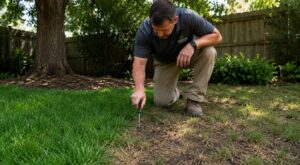
Test the soil with a screwdriver. Push a screwdriver into the ground. If it goes in easily, compaction is not the issue. If you have to force it, the soil is compacted and needs aeration before you do anything else.
Check soil moisture under the tree. Dig down about 2 inches with your finger or a probe. If that spot is dry while the grass 10 feet away is moist, tree roots are pulling the water before your grass can get it. You will need to water more deeply and directly in that zone.
Look at the tree species. If you have a black walnut, that changes everything. Juglone damage won’t improve much unless the source is removed or the affected soil is fully replaced working around it rarely helps.
Look for fungal signs. White powder on blades, circular brown patches or orange-red spots on leaf surfaces are all signs of disease not just drought or shade.
Read more: Planning Your Lawn: Grass Selection Guide 2026
What You Can Actually Do About It
Now the practical part. The fix depends on what you found during the diagnosis.
Let More Light In Before Anything Else
If the problem is a tree with a dense canopy, talk to a certified arborist about selective pruning. According to the University of Maryland Extension, no more than one-quarter of the foliage-bearing branches should be removed at one time. Pruning lower branches to at least six feet off the ground and thinning the inner canopy lets more light reach the grass below and improves air circulation at the same time. You don’t need to remove the whole tree. Just opening it up a bit makes a real difference.
If the shade comes from a fence, building or structure, pruning won’t help. In that case, skip straight to choosing a different grass variety.
Plant the Right Grass for Shaded Areas
This is the most important fix for most yards. Here is a quick breakdown:
Cool-season zones (northern states): Fine fescue is your best option. It can survive on as little as 3 to 4 hours of filtered light and handles poor soil well. Creeping red fescue, hard fescue and chewings fescue are all solid choices. Tall fescue works too but it needs a bit more sun around 4 to 5 hours minimum.
Warm-season zones (southern states): St. Augustine grass handles shade better than any other warm-season option. Palmetto and Seville are especially shade-tolerant cultivars. Zoysia is another good pick slower to establish but very resilient once it’s in.
One thing worth knowing: a seed blend often outperforms a single variety in tricky spots. Different grasses have slightly different tolerances so a mix gives you better overall coverage when conditions are not perfect.
Change How You Mow and Water
Shaded grass needs to be mowed higher at least 3 inches. Taller blades mean more leaf surface for photosynthesis, which is already limited. Avoid mowing during the hottest and driest weeks of summer. The grass is already stressed. Adding mowing stress on top makes recovery much harder.
For watering, shaded areas actually need less than full-sun lawn. Less direct heat means less evaporation. The soil stays moist longer. Overwatering is a very common mistake in shaded zones and it feeds fungal disease. Water deeply but less often. Let the soil dry slightly between sessions.
Fix the Soil Before You Reseed
If compaction is an issue, aerate first. Core aeration pulls small plugs from the soil and opens up space for roots, air and water. Do this before overseeding seed dropped into compacted ground rarely establishes well.
Clear leaf litter in the fall before it builds into a thick mat. The University of Connecticut Extension warns that a thick layer of leaves over weakened turf can increase disease, lower soil pH and even kill grass from lack of light and oxygen. You don’t need to remove every leaf but once it starts forming a dense, compacted layer, clear it before it smothers recovering grass.
On fertilizing: less is more in shaded areas. At Ex Landscaper, we have seen homeowners over-fertilize shaded spots thinking it will help the grass recover. It usually makes things worse. Nitrogen encourages fast shoot growth but without enough light, the plant can’t recover the energy that growth costs. Stick to about 1 to 2 pounds of actual nitrogen per 1,000 square feet per growing season. Apply it in fall for cool-season grasses.
When Grass Just Won’t Work What to Do Instead
Sometimes the honest answer is that there is not enough light for any grass to survive even the most shade-tolerant varieties. If you have tried the right grass, adjusted your care routine and the area still goes bare every year, it’s time to consider a different approach.
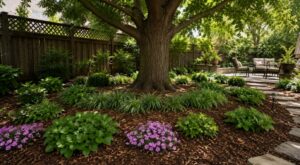
Mulch is the most practical solution. The University of Maryland Extension recommends a 2 to 3 inch layer of wood chip mulch under trees keeping a 6-inch buffer around the trunk free of mulch to avoid bark injury. It protects the soil, reduces compaction from foot traffic and eliminates the mowing damage to the trunk. It also keeps moisture in the soil, which benefits the tree itself.
Groundcovers are another solid option. Pachysandra, liriope and creeping phlox all handle shade well and spread on their own over time. They won’t look like a lawn but they will cover bare soil without the constant effort of fighting nature in an area that was never meant for grass.
Read more: How I Decorate My Lawn Over the Holidays: Homeowner Dos and Don’ts
The END
Grass doesn’t die in shade for one reason. It’s usually a combination — not enough light, wrong light quality, root competition, fungal pressure, compacted soil and sometimes tree chemistry all hitting at once. The fix is not always more seed or more fertilizer. It starts with figuring out which of these problems you are actually dealing with.
Walk the area. Test the soil. Count the hours of sun. Then make your move. That’s how you stop repeating the same frustrating cycle every spring.
Read more: Cool-Season Grass Comparison: Make your decision fast
FAQs
1. Can any grass survive in full shade?
Not really. Even the most shade-tolerant varieties need at least 3 to 4 hours of filtered sunlight each day. If a spot gets less than that, no grass will hold up long-term. Groundcovers or mulch are a better fit for those areas.
2. Why does my grass keep dying under my oak tree even after I reseed?
Oak trees have wide, aggressive root systems that compete with grass for water and nutrients often beyond the visible canopy edge. The shade alone is one problem, but root competition is usually the bigger one. Reseeding without addressing the roots and light will give you the same result every time.
3. What is the easiest grass to grow in shade?
For cool-season zones, fine fescue especially creeping red fescue is the most shade-tolerant option and handles low-fertility soil well. For warm-season zones, St. Augustine grass, particularly the Palmetto cultivar, performs best in shaded conditions.
4. Does overwatering cause grass to die in shade?
Yes and it’s a common mistake. Shaded areas evaporate less moisture, so the soil stays wet longer. Overwatering in these spots creates the damp, humid conditions that fungal diseases like powdery mildew and brown patch thrive in. Water deeply but less frequently in shaded zones.
5. Should I fertilize shaded grass more to help it recover?
No…. The University of Missouri Extension specifically advises against heavy nitrogen fertilization in shaded areas. Extra nitrogen pushes fast shoot growth but without enough light the plant burns through its energy reserves faster than it can replenish them. One to two pounds of actual nitrogen per 1000 square feet per growing season is enough.
6. When should I just give up on growing grass in shade?
When you have used the right shade-tolerant variety, adjusted your mowing and watering, improved the light where possible and it still fails year after year. At that point, the area likely does not get enough light for any grass to survive. Mulch, groundcovers or shade-tolerant plants are the practical next step. Bye Bye……
Read more: Fine Fescue: The Smart Choice for a Gorgeous Low-Maintenance Lawn