Have you ever wondered why not many bees or birds come to your garden, while the neighbors garden is always full of life? A big reason for this could be native plants. These play an important role in increasing biodiversity. We often get this question from homeowners who want a garden that will attract wildlife but also be easy to take care of. Today we will learn exactly this: what native plants are, why they are important and how you can easily start adding native plants to your lawn.
What Are Native Plants?
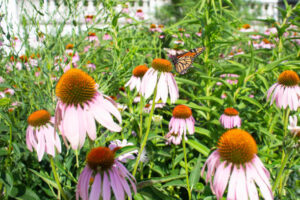
Native plants are trees that have been growing in our area’s natural environment for a long time. These have grown up adapting to the local soil, weather, rainfall and wildlife. So they don’t need very much care to survive.
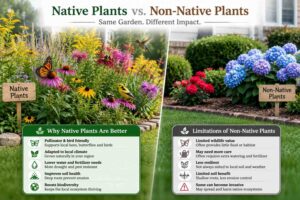
On the other hand, non-native plants are mainly brought in from another region or country. Most of them don’t cause any problem. But some plants become invasive, meaning they spread quickly and take over the space of local plants. And that is why many people think of these as native plants, such as English ivy and creeping thyme. But actually these have been brought in from another region.
Knowing this difference is important, because a plant may look beautiful and healthy but it may not provide much benefit to local birds, bees or butterflies.
Why Native Plants Are Important for Biodiversity
The Keystone Plant Concept
Not all native plants are equally important. Entomologist Doug Tallamy of the University of Delaware has researched for years which plants actually play a bigger role in the life of insects. And research has shown that only a few native plants play an important role in the survival of most insects. About 5 percent of native plant species support 75 percent of caterpillar species and only 14 percent support 90 percent. These high-value plants are called keystone species.
The Bird Connection
This is more important than most people think, because caterpillars are baby birds’ food. A study done on Carolina chickadees found that these birds cannot successfully raise their young in gardens where less than 70 percent of the plants are native. A group of chickadee chicks needs 6,000 to 9,000 caterpillars to reach fledgling age. Generally among bird species, 96 percent of land birds depend on insects to feed their young, most of which are caterpillars.
In other words, a garden full of ornamental non-native plants may look beautiful but it can remain nearly silent for birds, because it cannot produce enough insect food.
Oak Trees Are at the Top of the List
Among keystone plants, oak trees are one of the foremost. A single oak tree alone can shelter more than 950 caterpillar species, which is more than almost any other tree in North America. So if we have the opportunity to plant one keystone plant in our garden, the oak tree can be the best choice.
The Problem With Traditional Lawns
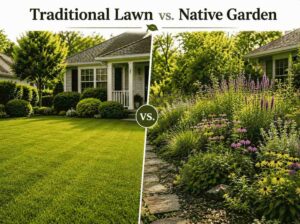
Turfgrass is by area the most irrigated “crop” in the United States, spread across an estimated 30 to 40 million acres of American gardens. Homeowners apply about 10 times more pesticide and fertilizer per acre on lawns than farmers apply per acre of agricultural crop.
Water use tells the same story. On average, an American family uses about 320 gallons of water per day. About 30 percent of this is used outdoors and more than half of that 30 percent of water is used on lawns. In dry areas this amount can be even higher.
However, this does not mean the whole lawn has to be removed. Even planting native plants in just one part of the lawn can considerably reduce water use, the need for fertilizer and pesticide and maintenance time.
How to Choose Native Plants for Your Zone
If you are thinking about gardening in USDA Hardiness Zone 5-7, the following native plants can be good options for you.
For sunny areas:
– Little Bluestem (Schizachyrium scoparium) is a native ornamental grass that supports pollinators and keeps visual interest even in winter.
– Creeping Phlox (Phlox subulata) tolerates poor, rocky soil and grows well in Zone 5-8 areas.
For shaded areas:
– Pennsylvania Sedge (Carex pensylvanica) is a low, grass-like ground cover suited for dry shade with minimal mowing
– Golden Ragwort (Packera aurea) is often used as a native alternative to English ivy
– Green-and-Gold (Chrysogonum virginianum) is a spreading ground cover suited for Zone 5-9
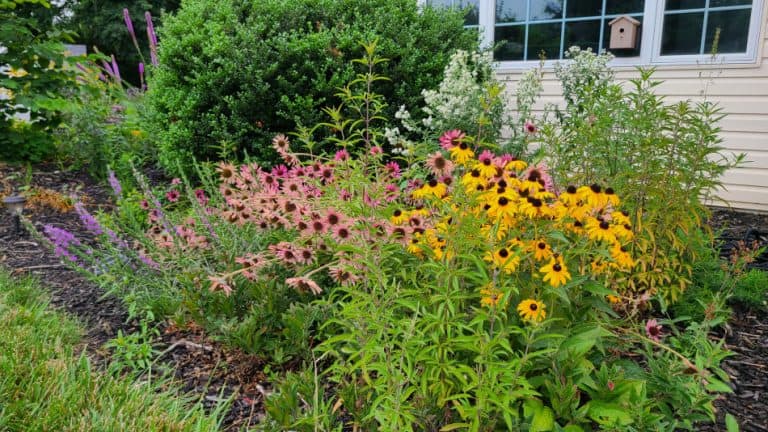
These plants can be layered along the edge of an existing lawn or used entirely in place of turf in shaded areas where grass is hard to grow.
How to Convert a Part of Your Lawn to Native Plants
To change a small part of the lawn to native plants, we can follow the steps below:
1. Look at the area carefully: We should first check how much sun it gets, what type of soil it is and how quickly water drains away after rain.
2. Choose native plants suited to your own area: For this, we can get proper advice from a local native plant society or state extension office.
3. Remove the existing grass: You can pull it out by hand, or use a sod cutter for a larger area or cover it with cardboard and mulch for a few weeks to kill the grass.
4. Prepare the soil: Mixing in some compost helps native plants grow roots faster, especially in hard or compacted soil.
5. Plant the plants: Instead of mature plants, planting small plugs is usually more affordable and often grows well too.
6. Mulch and water: In the first season, regular watering is important until the plant’s roots become strong.
7. Maintain throughout the first year: Some native plantings may need occasional trimming in the first year so there is less weed pressure while the native species become established.
Here our advice is not to change the entire lawn at once. Rather, start with a small section. This makes the work easier, makes weed control more manageable and also lets us understand which plants grow well in our garden.
How Much of Our Lawn Should Have Native Plants?
To make a difference, you do not need to go 100 percent native. The National Wildlife Federation recommends aiming for 50 to 70 percent native plant coverage in a home landscape to meaningfully support local wildlife. This leaves enough room for a play area, a patio or whatever part of the lawn your family actually uses.
A Cutting-Edge Trend
The use of native plants keeps increasing continuously. National Wildlife Federation survey data shows that the share of American adults converting a part of their lawn to natural or wildflower landscaping was 9 percent in 2019, which reached 12 percent by 2023. This represents an estimated 32.3 million people. If you are considering this for your own garden, then you are about to become part of a trend that is cutting-edge.
Some Common Mistakes Beginners Make
Even with good planning, many people make some common mistakes in the first year. I believe that if these can be avoided, native plants will establish more easily.
Tilling the whole area at once: Benjamin Vogt, author of A New Garden Ethic and owner of the prairie-inspired design firm Monarch Gardens, calls tilling the worst way to remove a lawn. In his experience, tilled soil brings such an aggressive wave of weeds that they overwhelm the new native plants before they can get established.
Starting work without properly looking at the site: Starting to dig directly without first checking sun exposure, soil type, and drainage is one of the most common early mistakes. A gardener shared this experience: they started work without properly evaluating the site, and the result was a weedy, only partially successful planting.
Converting too large a portion at once: A University of Maryland Extension case study shows that instead of changing the whole lawn right at the start, it is better to start with a small section. This is often done over several years, starting with just one border or bed and expanding it over time until eventually the whole garden is done.
Using too much mulch: Wild Ones, the native plant nonprofit behind the Less Lawn More Life initiative, lists over-mulching, along with improper plant placement, as one of the most common mistakes beginners make when starting a native garden.
FAQs
Is it expensive to convert from lawn to native plants?
The cost depends a lot on the scale. Starting with small plugs instead of mature plants, and converting one section at a time instead of the whole garden, keeps the cost manageable for most homeowners.
Will native plants make my garden look messy?
If you plan the layout, it will not look messy. In this case, we can use a defined edge around the native planting, such as a low border or a mowed strip, so that it does not look neglected.
Do I have to remove the whole lawn?
No. Even converting 30 to 50 percent of the lawn to native plants can, according to the research discussed above, meaningfully increase the insects and birds your garden supports.
How do I know which plants are native to my area?
Just looking at the hardiness zone is not enough. In this case, it is best to find out from your own areas state native plant society or local extension office.
Can native and non-native plants be kept together?
Yes, there is no need to change all the plants at once. A beautiful, wildlife-friendly garden can also be created by adding native plants gradually.
Conclusion
Native plants are not just a landscaping trend. They are the foundation of the local food chain, from insects all the way to the birds in your backyard. So whether you plant native plants in a small part of your lawn or a large part, every plant contributes to protecting local biodiversity. I hope today’s article will be of great help to you. Best wishes to you. Bye bye……………