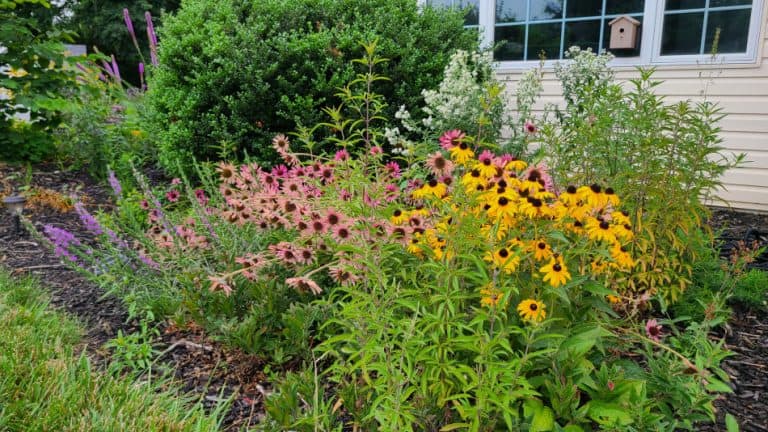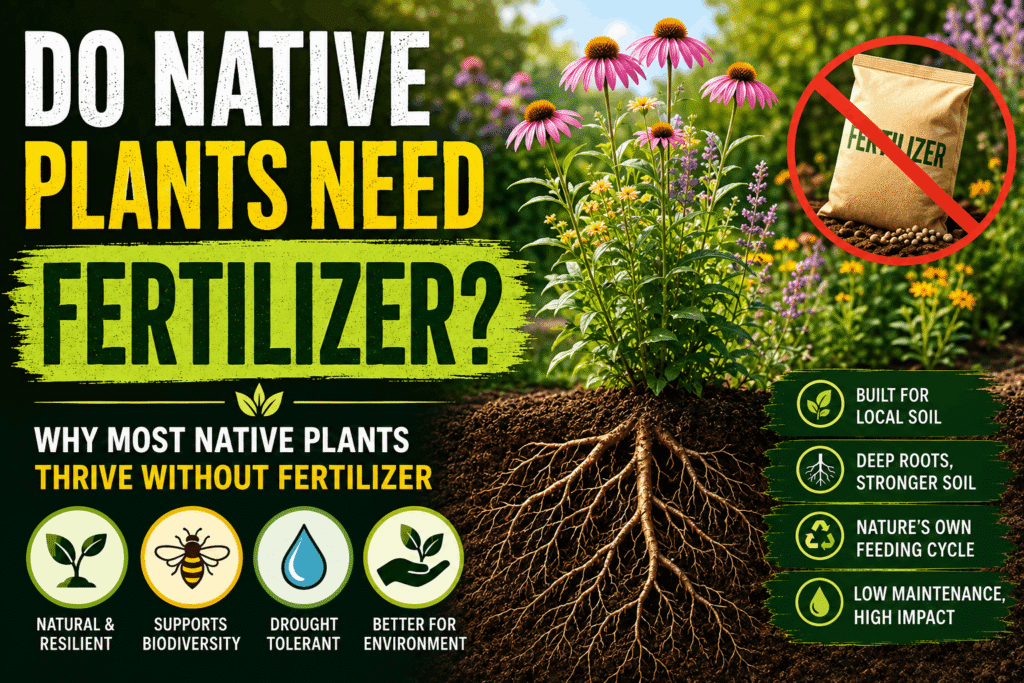
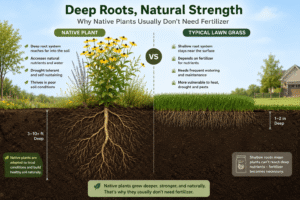
Most native plants do not need fertilizer. This is because they have evolved in our local soil for thousands of years. So their roots already know how to find the nutrients they need. And adding fertilizer often does more harm than good.
Why Native Plants Usually Don’t Need Fertilizer
Native plant roots reach deep into the soil. Where shallow-rooted plants cannot reach, these can collect water and nutrients from there too. And this deep root system also improves soil structure over time.
Nature has its own feeding system too. For example, fallen leaves and dead plant matter decompose in the soil. This process returns nutrients to the soil every year. So native plants take part in this cycle without any help from us.
While studying and observing native plants, I have consistently noticed one thing healthy soil has a much greater impact on the plant’s long-term growth and health than regular fertilizer application. Native plants that are well matched to the right growing conditions usually establish easily and need very little extra fertilizer.
When Fertilizer Might Actually Help
New transplants: Freshly planted native plants have small root systems. At that stage, they cannot draw nutrients from far away. A light starter treatment can help them adjust, especially when the soil is cold.
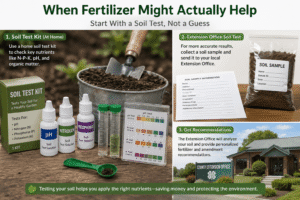
Poor or disturbed soil: Construction work removes topsoil and compacts the soil underneath. Native plants planted in this kind of soil may need extra support until their roots become established. At this time, the best way to be sure is a soil test. We would take small samples from a few spots in the planting area, mix them together and send them to the local extension office. The results would usually give specific recommendations based on nutrient levels, pH and soil type, so we wouldn’t have to guess.
Container-grown native plants: Plants grown in pots have limited soil volume. And so their nutrients may run out faster than plants grown in open soil.
Read More: Native Plants & Biodiversity Complete Beginner Guide 2026
The Risk of Over-Fertilizing
Over-fertilizing is mainly what creates the real problem. Then the plant grows fast but it grows weak. This soft growth attracts insects and increases the chance of catching disease. Fast growth also lowers the plant’s drought tolerance, which defeats one of the main reasons people choose native plants in the first place.
Extra fertilizer doesn’t stay in your yard. Rain washes it into storm drains and nearby streams. This runoff can also harm local waterways.
Signs That Show Whether a Plant Actually Needs Nutrients
The best first step is a soil test. It tells you exactly what is and isn’t present in your soil.
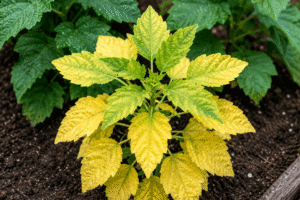
Watch the plant too. When older leaves turn uniformly pale yellow or light green, that often signals a nitrogen deficiency. A complete stop in growth is another sign. But keep in mind that for some species, some yellowing can be a normal seasonal change too, so not every yellow leaf should be assumed to be a deficiency.
Read More: Building Soil Biology Naturally: A Wiley Western Homeowner Guide
Alternatives to Fertilizer (Better Ways)
Compost and mulch aren’t technically fertilizer. They are soil amendments. Understanding this difference is important. Fertilizer feeds the plant directly, while compost and mulch feed the soil, which then slowly feeds the plant.
For new planting areas, mix compost into the top six to eight inches of soil, at roughly a ratio of one part compost to three parts existing soil. For established gardens, working in a one-inch layer of compost lightly into the surface each year is enough to maintain soil health.
Mulch works differently. Instead of mixing it into the soil, it should be spread on top. A two-to-three-inch layer of shredded leaves or bark holds in moisture, blocks weeds and slowly feeds the soil as it decomposes. Don’t let mulch pile up against the plant’s stem, as this can trap moisture and create a chance of rot.
Read More: Soil Testing and Solutions Complete Guide
FAQs
Do native plants need fertilizer to bloom?
No, most native plants bloom regularly without any fertilizer, because they evolved to bloom using only what the local soil provides.
Can fertilizer kill native plants?
Yes, in some cases. High concentrations of fertilizer can damage or kill young plants and roots, especially in the case of freshly planted transplants.
Is compost the same as fertilizer for native plants?
No, compost is a soil amendment, not a fertilizer. It improves soil structure and releases nutrients slowly, but it usually doesn’t provide the same concentrated amount of nutrients as fertilizer.
What’s the best fertilizer if native plants need one?
A balanced, slow-release fertilizer works best because it releases nutrients gradually instead of all at once.
Read More: I Spent $47 Building This Compost Bin My Lawn Has Never Look Better
Conclusion
Native plants are built in such a way that they stay healthy without regular fertilizer. So in most cases we should avoid fertilizer and let the soil’s natural cycle do the work. But it’s good to reserve fertilizer for exceptional situations new transplants, poor soil or container-grown plants that clearly need extra support. When in doubt, a soil test is always better than guessing. Okay thanks for reading and if you have any question you can comment me. bye bye……