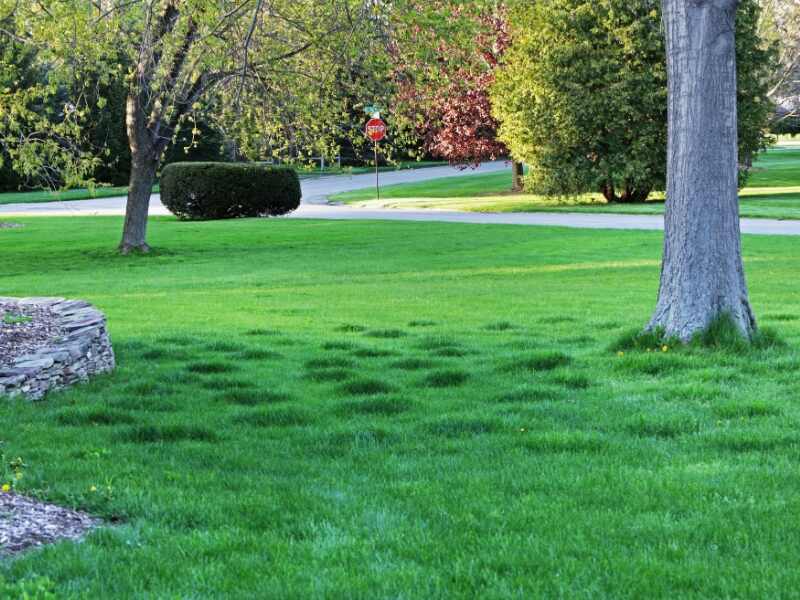
A healthy lawn does not need grub killer every year. However, if grubs have damaged your grass before or a part of your lawn lifts up like a loose carpet, in my experience, choosing the right product at the right time is more important than which brand you buy. Using the wrong product at the wrong time can waste money.
In this article, I have explained which product is more suitable for dealing with grubs in different situations and what the limitations of each product are.
Let’s Confirm the Problem Before Buying Grub Killer
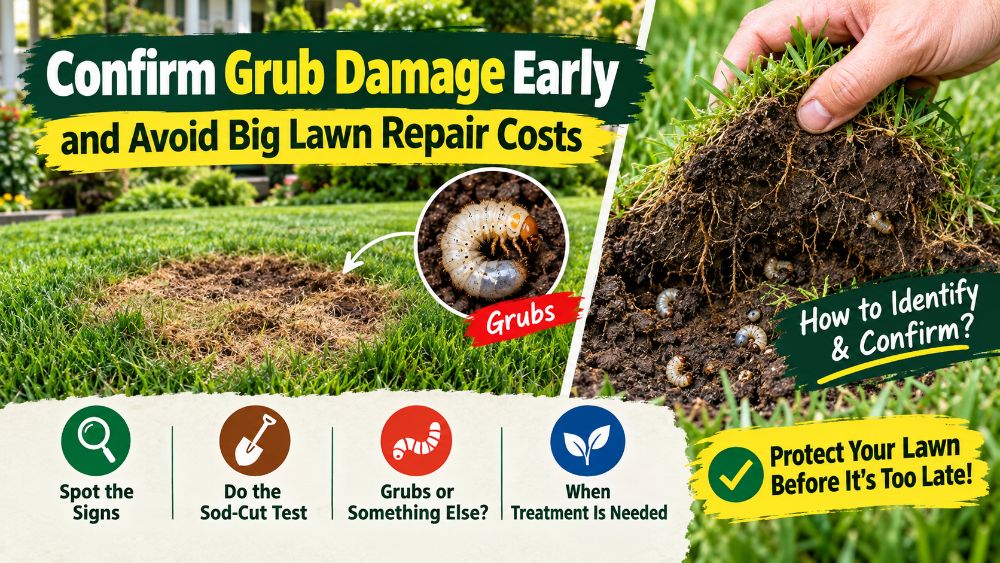
Just because the grass has turned brown does not necessarily mean that your lawn has grubs. Drought, grass diseases, or compacted soil can cause the same problem. So, dig up several pieces of grass measuring approximately 12 inches around the damaged area to a depth of about 2 inches. Check whether there are white, C-shaped grubs in the soil.
Finding a few grubs does not necessarily mean that treatment is needed either. On the other hand, even if a healthy lawn that receives rain or irrigation has five or more grubs per square foot, visible damage may not occur.
However, the grub species is also important here. According to information from Colorado State Extension, some species of small grubs in May or June can damage grass even when their numbers are low.
Well, if you are still unsure whether you have grubs, read my article Confirm Grub Damage Early and Avoid Big Lawn Repair Costs.
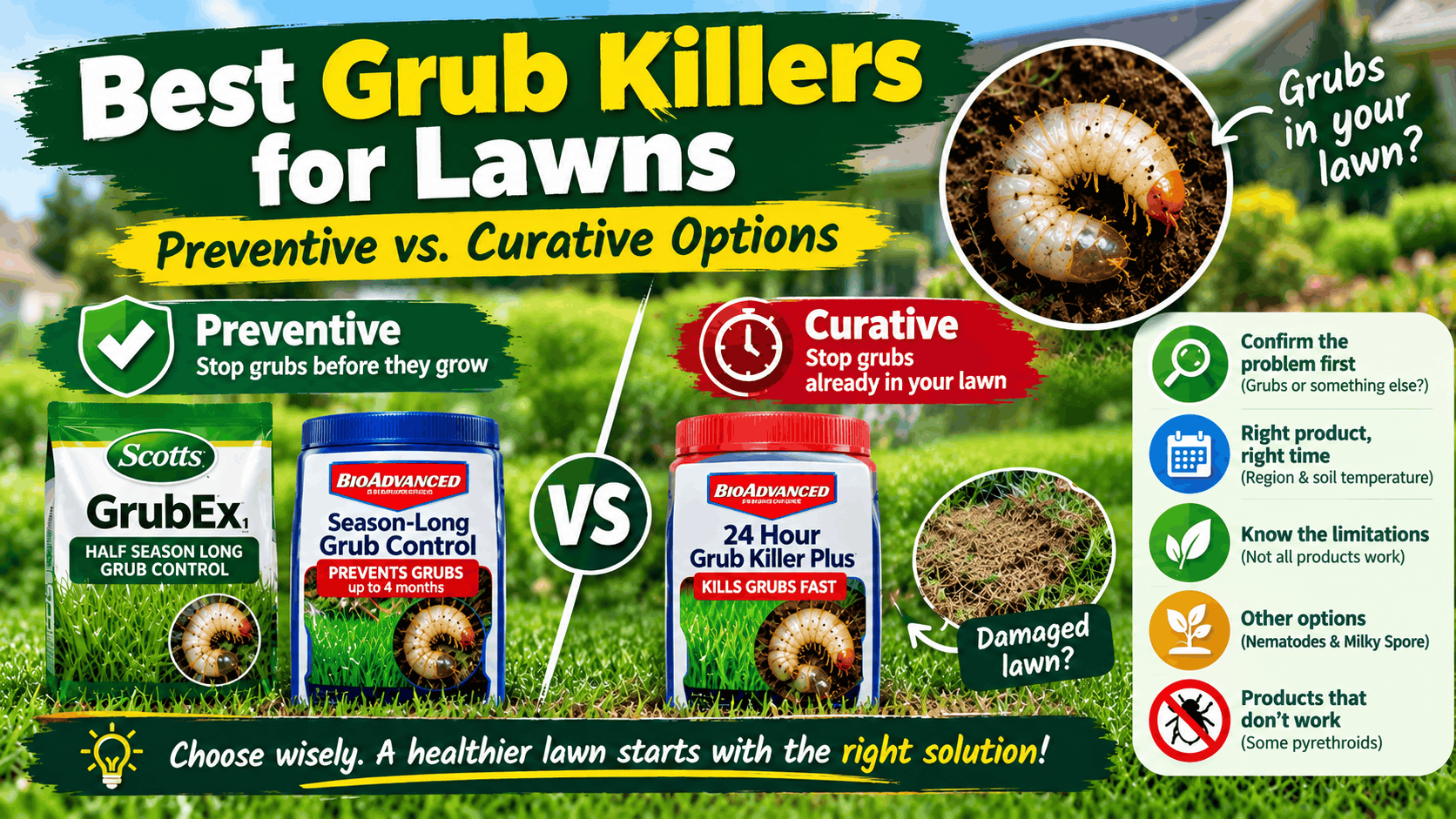
Best Grub Killer for Lawns
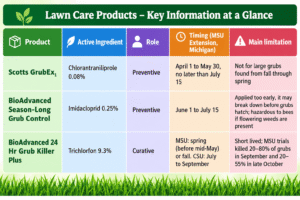
These are generally very popular products. In the table below, I have presented the role, application timing and limitations of each product in simple terms.
I have provided the timing information according to the recommendations of Michigan State University Extension. However, the correct application timing may vary depending on the area where you live. Therefore, I recommend that you always follow the product label instructions.
The Right Time to Control Grubs Varies by Region
It is not appropriate to apply grub control products at the same time in every region. The correct timing depends on soil temperature, weather and when beetle eggs hatch.
The recommendations of Michigan State University Extension apply to Michigan. On the other hand, Colorado State University Extension recommends applying GrubEx from May to June and products containing imidacloprid from June to early August. According to them, applying preventive products close to the time when eggs hatch produces better results. For Japanese beetles, this period is generally from mid-June to early July.
Therefore, considering these factors, consult your local Extension office before deciding on the application date and follow the product label instructions.
Let’s Understand Each Option in More Detail
1. Scotts GrubEx₁ (Preventive)
Scotts GrubEx₁ contains an active ingredient called chlorantraniliprole. It is mainly used to control grubs before they grow larger.
According to MSU Extension, this chemical is not highly soluble in water. Therefore, it can be applied early in the season. Generally, applying it before June produces better results than applying it in June or July.
According to Colorado State Extension, it gradually moves deeper into the soil and remains effective for a long time. It also poses a comparatively lower risk to bees.
However, remember that GrubEx₁ is intended to control grubs in advance, not to kill them quickly after an infestation has already occurred. It mainly works well against young grubs.
2. BioAdvanced Season-Long Grub Control (Preventive)
It contains an active ingredient called imidacloprid. It is used to control grubs, but when you apply it is also very important in this case.
According to the recommendations of MSU Extension, it is better to apply this product in June or July rather than early spring. This is because applying it too early may cause the chemical to move through the soil or lose its effectiveness before the grubs hatch.
Another important point is that imidacloprid can pose a risk to bees. You need to be especially careful if there are flowering plants in your lawn. Therefore, I recommend mowing the grass before application.
You can also use BioAdvanced Complete Insect Killer at the same time. It contains imidacloprid and cyfluthrin.
3. BioAdvanced 24 Hr Grub Killer Plus (Curative)
This product contains an active ingredient called trichlorfon. It is different from preventive products and is used to control grubs when an infestation appears in the lawn.
MSU Extension has also mentioned two chemicals, trichlorfon and carbaryl, for curative grub control.
Trichlorfon works quickly, but it does not remain effective in the soil for long. According to Colorado State Extension, it may break down even faster when the soil pH is high.
Therefore, it may be useful when a grub infestation appears in the middle to late summer. Water the lawn immediately after application so that the chemical can reach the soil.
However, one thing is important to remember: I will not guarantee that all grubs will die simply by using these products. They can help control grubs quickly, but it is not reasonable to expect complete elimination.
Other Options
1. Beneficial Nematodes (Biological Method)
Beneficial nematodes are tiny worm-like organisms that can help control grubs living in the soil. Both MSU and Colorado State Extension (CSU) have mentioned the species Heterorhabditis bacteriophora as a biological option for grub control.
However, I recommend keeping a few things in mind when using them:
- Choose the right species: Not all nematodes can control lawn grubs. Therefore, before buying, check whether Heterorhabditis bacteriophora is listed on the product label.
- Water immediately after application: You need to help the nematodes reach the soil with the water.
- Keep the soil moist: The soil needs to remain moist for several days after application.
If applied correctly, this method may produce good results. However the effectiveness of biological products is not always consistent, and results can vary. Therefore beneficial nematodes can be used, but there is no guarantee that they will work equally well in every situation.

2. Milky Spore (Biological Control Method)
Milky Spore is a biological product used to control grubs. However there are considerable questions about its effectiveness in controlling lawn grubs.
According to information from Wisconsin Extension, recent research has not established this method as effective. On the other hand, Colorado State Extension has reported that its use may reduce grub populations by less than 5 percent.
In other words, it is not advisable to rely solely on Milky Spore for grub control. It is important to have realistic expectations about its effectiveness before using it.
Products That Do Not Work for Grub Control
According to information from MSU Extension, Spectracide Triazicide (gamma-cyhalothrin) and current Sevin Lawn Granules (bifenthrin and zeta-cypermethrin) are not effective for grub control.
The reason is that these types of pyrethroid-based insecticides mainly work on the soil surface. However, grubs live beneath the soil and feed on grass roots. Therefore, these chemicals generally cannot reach the grubs.
However, these products may control some other insects living on the soil surface.
Remember one thing: if a product contains these ingredients along with a preventive ingredient proven effective for grub control, it may work against grubs.
Preventive vs. Curative Grub Killer: What Is the Difference?
Preventive products are used to control grubs while they are still small. In other words, these products are applied to the soil in advance.
On the other hand, curative products are used when grubs are already present in the soil and are feeding on grass roots. In other words, one is used to control grubs in advance, while the other is used after an infestation has begun.
According to MSU Extension, preventive products work well against newly hatched, small grubs. However, they are not as effective against larger grubs present between September and May. Therefore, when a large-grub infestation occurs, a curative product may be a chemical option. However, I would say that their effectiveness generally lasts for a short time, and the results may be less satisfactory than those of preventive products applied at the right time. MSU Extension has also advised against applying curative insecticides after May 15. This is because grubs may stop feeding during this period and move into the pupal stage or the next stage of development.
In short, using preventive products at the right time generally produces better results. However, you must first confirm that there is actually a grub problem in your lawn. And if you see an infestation of large grubs, you should consider an appropriate curative product.
How to Choose the Right Product
- If your lawn suffered confirmed grub damage in the previous year, plan a preventive treatment for the next season. MSU recommends considering treatment if approximately 10 or more grubs are found per square foot.
- If your lawn is dense and has never suffered grub damage before, treatment may not be necessary. The idea that treatment is needed every year is incorrect. If there are no signs of grubs in a treated lawn the following year, you can stop treatment.
- If grubs are currently feeding on grass roots and causing damage, choose a curative product. However, expect only partial control of the grubs.
- Apply the product at the right time according to its active ingredient. Chlorantraniliprole is applied earlier. In Michigan, it is applied from April to May, and in Colorado, from May to June. On the other hand, imidacloprid is generally applied in June or July. In Colorado, it is applied until early August.
- Do not buy a product by looking only at the name on the front of the package. Check the active ingredient on the label.
- Water immediately after application. MSU and Wisconsin Extension recommend applying at least half an inch of water. An Ask Extension response from Colorado mentions applying 1 inch of water for GrubEx. However, you can follow the instructions provided on the product label.
- Mow the grass before applying treatment. I recommend mowing the grass before applying these products so that weeds do not have flowers. This helps protect bees.
- Understand the limitations of treatment. Even when grubs are controlled in the lawn, the number of adult Japanese beetles feeding on rose plants or tree leaves may decrease only slightly. This is because these adult insects may fly in from other places.
What to Do After Grub Treatment
Grub killer helps stop grubs from feeding, but dead grass does not grow back. Therefore, remove the loose grass that has lost its roots. Then, sow grass seed again in the bare areas.
Additionally, continue to water and fertilize the affected lawn regularly after applying curative treatment. At the same time, plan a preventive treatment for the following summer. Otherwise, the problem may return.
Mow the grass at a height of 3 to 4 inches. This helps grass roots grow deeper and increases the grass’s ability to tolerate feeding damage caused by grubs.
Add the link to the article about reseeding bare patches in your lawn here.
Anyway, if you want to learn about reseeding bare patches, read our article The Best Way I have Found to Reseed Bare Patches in Your Lawn.
Conclusion
The best grub killer is the one that matches your lawns condition and timing. First, make sure grubs are actually the problem, because many healthy lawns do not need treatment at all. If damage has already been confirmed, a properly timed preventive, such as GrubEx or an imidacloprid-based product, is a more effective approach. But if grubs are actively feeding on the roots and causing damage now, a curative such as trichlorfon is the main option, though you should expect only partial control. Timing varies by region and active ingredient, so it is recommended to check the product label and consult your local Extension office before buying.