Grass is high maintenance. Always has been. You water it, mow it, fertilize it four times a year and the moment summer hits hard it still turns brown anyway. A lot of Western homeowners have quietly started asking the same question: is there something better?
Clover keeps coming up as the answer.
We have worked with enough yards across the West to know that clover comes up as a serious option more often than people expect — especially after a second brutal dry summer in a row.
It’s not a new idea either. Clover was actually a standard part of lawn seed mixes until the 1950s, when broadleaf herbicides were invented and clover became an unintended casualty. [GrowYourPlant] Decades later, it’s making a real comeback and this time people are not planting it by accident.
A Clover Lawn Isnt What Most People Think
When people hear “clover lawn” they picture weeds taking over a neglected yard. That’s not this.
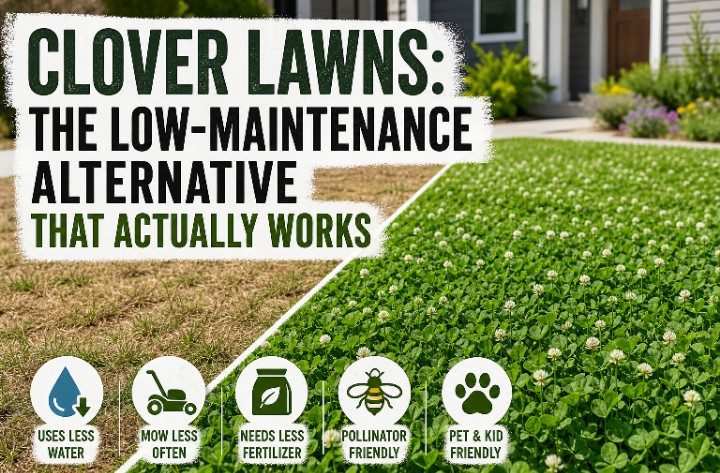
Clover is a dense ground cover known for its shamrock-shaped leaves and pollinator-friendly flowers. Though you can grow a single-species clover lawn, most experts recommend mixing clover with traditional grass or with a variety of different clover species for an even, green lawn. [LawnLove] White Dutch clover and microclover are the most popular picks for residential yards. Both stay low. Both spread on their own. Neither asks much of you once they are settled in.
Microclover is the tidier version it grows only 2 to 4 inches tall and blends into existing turf without looking out of place. White Dutch clover is the classic choice, growing 4 to 8 inches with white flowers that bees love. [GrowYourPlant] Pick based on your priorities. Tidier look? Go microclover. Full pollinator habitat? White Dutch.
Read more: Rain Barrel System: Save Water and Money the Smart Way
The Mowing Reality
People always assume this part is exaggerated. It isn’t
A clover lawn typically needs far fewer mowings than a traditional grass lawn often just a couple of times per season in most climates. That’s a serious time savings compared to the weekly grass routine, though how often you actually mow depends on your yard and how tidy you want things to look.
You don’t need to mow a clover lawn as frequently as a grass lawn. Twice a year is enough once after the clover has bloomed and dropped its seeds and once again a month before the first frost. [The Old Farmer’s Almanac] In our experience, most homeowners end up mowing three to four times through the season just to keep edges neat not because the clover demands it. But you are never locked into that weekly grind either way.
Water Bills in the West Are No Joke
California Arizona Nevada Oregon in summer. These places know what it means to watch the hose running and wince at the bill coming.
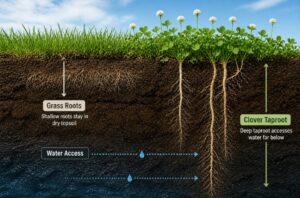
Clover lawns stay green even during dry spells with minimal watering, making them an attractive choice for areas with water restrictions or dry climates. [NaturaLawn] The reason comes down to root depth. Strawberry clover’s deep taproot system allows it to access water reserves deep within the soil, enabling it to maintain its green appearance even during short dry spells. [ScottsMiracle-Gro] Regular turfgrass roots don’t go that deep. When the top layer dries out, grass browns fast. Clover keeps going.
Traditional grass needs roughly 1 to 1.5 inches of water every week through summer. Most clover varieties get by on a fraction of that. We have seen front yards in Southern California go through July and August on almost no supplemental watering once the clover was fully established — something that would have killed a fescue lawn in two weeks. For families in drought-prone regions, that gap in water use adds up quickly over a season.
It Feeds Itself Mostly
Grass lawns typically need fertilizer four times a year. That’s money, time and synthetic chemicals going into your soil every few months.
Clover works in harmony with nitrogen-fixing bacteria to convert atmospheric nitrogen into usable plant fertilizer. [ScottsMiracle-Gro] The lawn essentially feeds itself through this process. Mix clover into your grass at roughly a 1:4 ratio and many homeowners find they can cut back significantly on synthetic fertilizer or skip it entirely. It depends on your soil conditions and local climate, but the reduction is real and noticeable for most yards.
That’s not a small thing. Fertilizer costs add up fast and many homeowners would rather not have those chemicals near kids and pets anyway.

Weeds Struggle to Move In
The dense spreading habit of clover helps push out a lot of common weeds before they get established. For many homeowners that means less reliance on herbicides. Clover keeps new weeds at bay, reduces your need for herbicides and improves soil health to reduce the need for fertilizer. [American Meadows] Results do vary by soil type and climate but the weed suppression benefit is one of the more consistent things people notice early on.
For homeowners who spend money on weed killers every spring, this is one of the more underrated wins.
Read More: Stop Crabgrass Dead Best Organic Pre-Emergent Alternative for Lawn
About the Bees Honest Answer
This part needs a straight answer, not a cheerful spin.
Clover flowers attract bees. A lot of them. For your garden and local ecosystem that’s genuinely good pollinators are under real pressure across North America and a clover lawn does meaningful work supporting them.
But if someone in your household has a bee sting allergy, this matters more than the benefits. Be cautious if you or your kids have an allergic reaction to bee stings. The practical fix is simple mow before the flowers fully open. No blooms means far fewer bees visiting. Problem largely managed.
Kids and Dogs What to Actually Expect
Many pet owners find clover shows fewer brown patches from dog urine than traditional turfgrass does. It tends to be more resilient in those spots. Results vary depending on how frequently and where your dog goes, but it’s a common reason pet owners make the switch.
Clover is resilient and can withstand foot traffic, making it good for pathways and yards. [Xoxojackie] For families with kids running around daily, a clover-grass blend handles wear better than pure clover alone. Heavy play areas benefit from keeping some turf in the mix. Think of it as getting clover’s benefits where it counts while keeping grass where the abuse is highest.
Read more: Sustainable Lawn Resolutions 2026 Guide to an Eco Friendly Yard
Getting Started Without Committing the Whole Yard
No need to tear everything up. Most people start by overseeding one section of their existing lawn in early spring or fall. Clover seeds are small and inexpensive. Clover seed costs just $1 to $4 per 1,000 square feet compared to $10 to $30 for grass seed. [GrowYourPlant]
Loosen the top layer of soil first. One thing we see people skip too often, the soil pH check. If your soil runs too acidic or too alkaline, clover will germinate but never really fill in properly. A basic test kit from any garden center costs about $10 and saves a lot of frustration later. Check that your pH sits between 6.0 and 7.0 before you seed anything.
Then broadcast the seed by hand or with a spreader clover seed is light so it does not take much. Water it twice daily for the first week or two while it germinates. After that, back off and let the roots take hold. Most varieties fill in within four to six weeks.
Starting small is smart. One section of lawn tells you more about how clover performs in your specific yard than any guide can. If it takes well, expand. If your HOA pushes back, you haven’t committed the whole property.
When Grass Still Makes More Sense
Clover isn’t the right answer for every situation and it’s worth being upfront about that.
Heavy-use play areas where kids are grinding on the same patch every single day will wear clover down faster than a grass-dominant lawn. Dense shade is another real limitation most clover varieties need decent light to thrive. Very cold and arid climates can be tough going, though drought-specific blends like strawberry clover handle those conditions better than standard white clover.
Some HOAs still require a conventional lawn appearance. Worth a quick check before you seed anything.
So Is It Worth Trying?
Clover is not something we recommend to every homeowner who asks. Heavy shade extreme cold or a strict HOA can make it more trouble than it’s worth. But when the conditions are right, the results speak for themselves.
Clover is one of the more practical low-maintenance options out there for homeowners dealing with those exact frustrations — the water bills, the weekend mowing routine, the fertilizer schedule. It’s not a perfect fit for every yard or every climate.
But for the right situation, it gets you meaningfully closer to less work, lower water use and a yard that stays green without the usual grind. At Ex Landscaper the homeowners we hear from most are the ones who started with just one corner of their lawn and never looked back.
Try one section this spring. See what happens. Okay, thanks for reading, bye..